
SpaceX IPO filing gives crypto investors a new way to price Bitcoin exposure, X payments, and AI compute
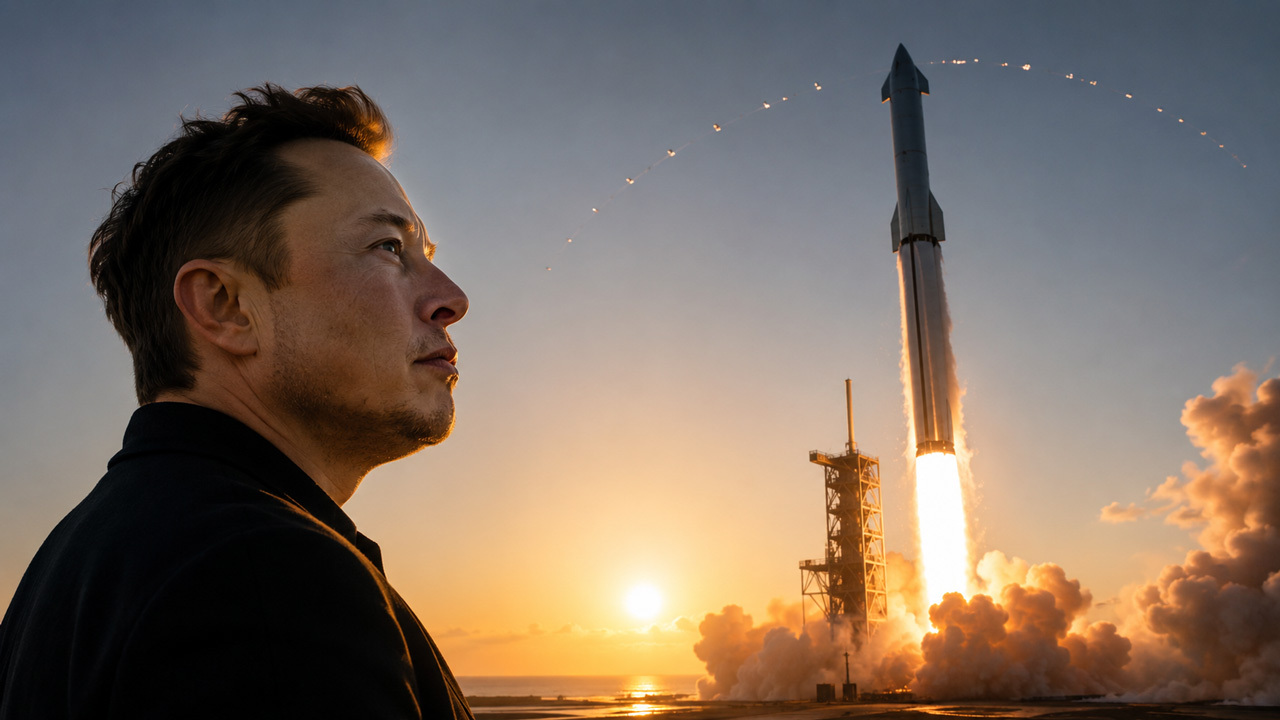
SpaceX’s IPO filing and revealed Bitcoin exposure have given crypto investors a formal benchmark for a company they had already begun trading before public markets received the prospectus.
On May 20, the firm submitted an S-1 filing with the US Securities and Exchange Commission (SEC), outlining the financial performance, risk factors, and growth ambitions of Elon Musk’s rocket, satellite, and artificial intelligence company ahead of a planned listing under the ticker SPCX.
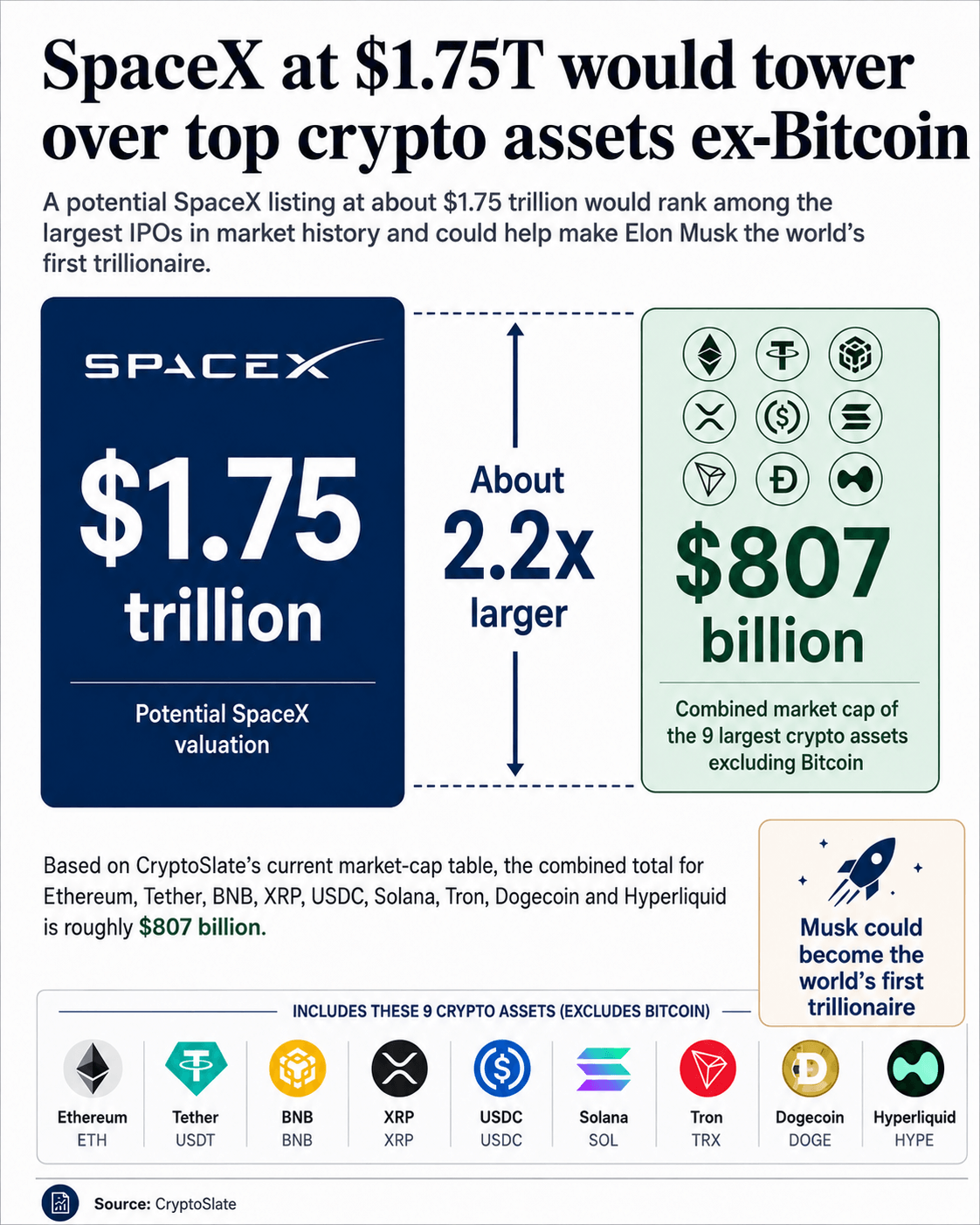
The potential listing could value SpaceX at about $1.75 trillion, making it one of the largest IPOs in market history. It could also make Musk the world's first trillionaire.
With such a personal fortune, Musk's wealth would be above the combined market capitalization of the 10 largest crypto assets excluding Bitcoin, based on CryptoSlate’s current market-cap table, which lists Ethereum, Tether, BNB, XRP, USDC, Solana, Tron, Hyperliquid, and Dogecoin at roughly $807 billion combined.
However, the crypto relevance of the filing goes beyond Musk’s wealth or SpaceX’s implied valuation.
The document gives traders a clearer view of three areas that overlap with digital-asset markets, including SpaceX’s Bitcoin holdings, X’s push into payments and banking, and a data-center strategy that could eventually compete with the AI-infrastructure narrative now supporting Bitcoin mining stocks.
SpaceX's Bitcoin balance sheet
SpaceX’s most explicit crossover into the digital asset market is visible on its balance sheet, resolving years of industry speculation driven primarily by wallet analytics and informal executive commentary
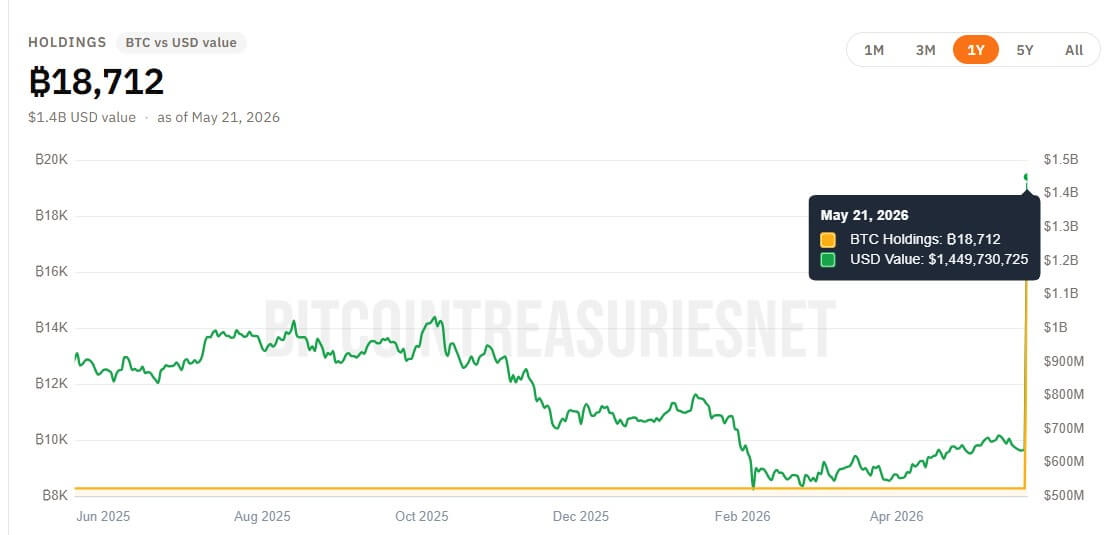
According to the S-1 filing, SpaceX held 18,712 Bitcoin as of March 31, 2026. The company disclosed a fair market value of approximately $1.29 billion for the position, compared with a historical cost of $661 million. This implies an average purchase price of roughly $35,324 per coin.
This disclosure firmly anchors SpaceX among the top ten corporate Bitcoin holders globally, mirroring a treasury philosophy popularized by firms like Strategy (formerly MicroStrategy), which commands the largest corporate allocation at 843,738 BTC, and Musk’s sister company, Tesla, which maintains a balance of 11,509 BTC.
Unlike dedicated corporate treasury plays, SpaceX treats its digital asset holdings as independent balance-sheet exposure. However, public-market accounting standards mean these holdings will introduce significant net income volatility for prospective SPCX shareholders.
Under current fair-value crypto accounting guidelines, public enterprises must measure eligible digital assets at market prices each quarter, passing unrealized gains and losses directly through their corporate earnings statements.
The structural impact of this rule is highlighted in the company's first-quarter performance metrics. SpaceX reported that its nominal inventory of 18,712 Bitcoin remained entirely unchanged from the end of 2025 through the first quarter of 2026.
Yet, because Bitcoin prices retraced toward the $70,000 level during the period, down from historical peaks above $126,000, the reported fair value of the block contracted from $1.64 billion to $1.29 billion.
This drop wiped hundreds of millions of dollars from reported income without a single coin being liquidated.
The firm stated that the coins are held with unnamed third-party custodians and revealed no plans for further acquisition or sales.
X's ‘Everything App' goal
The prospectus also outlines the corporate trajectory of the social network X (formerly Twitter), revealing an operational roadmap that closely overlaps with the consumer-utility thesis championed by crypto payment projects.
The filing described X as a platform being built toward an everything-app model, combining real-time information, communications, media, payments, banking, commerce, and AI features into a single consumer experience.
It also pointed to Money, a product launched in beta in November 2025, as part of the effort to expand platform utility through payments and financial services.
That puts X closer to the competitive field occupied by stablecoin issuers, crypto wallets, and consumer finance apps.
Stablecoin companies are trying to win payment volume by offering faster settlement, lower costs, and programmable money. Wallet providers are trying to become the interface for balances, identity, token storage, creator payments and peer-to-peer transfers.
X is approaching the same activity from a distribution perspective, beginning with a social network and layering financial tools into the user experience.
For the digital asset ecosystem, this model presents a dual-edged structural outlook. If retail consumers can hold balances, settle transactions, and compensate creators natively inside a mainstream social platform, the immediate consumer incentive to navigate the onboarding complexities of standalone cryptocurrency wallets declines.
Conversely, the infrastructure preserves substantial optionality; if X eventually introduces digital asset rails or stablecoin settlement within its existing regulated payments layer, it would immediately become one of the world's largest distribution networks for digital assets.
SpaceX brings deeper capital into the Bitcoin miner AI trade
Perhaps the most fundamental threat to the current crypto narrative lies in SpaceX’s artificial intelligence ambitions, which directly overlap with the “power-and-compute†pivot that is propping up Bitcoin mining stocks.
Faced with rising mining difficulty and halving pressures, public Bitcoin miners have spent the past two years re-architecting their facilities to host artificial intelligence workloads. Miners have consistently pitched institutional investors on the value of their terrestrial land rights, high-voltage electrical substations, and industrial cooling setups.
Industry estimates from firms like CoinShares suggest public miners could draw up to 70% of their top-line revenue from AI data hosting by the end of this year, having secured more than $70 billion in cumulative GPU colocation and cloud agreements through early 2026.
SpaceX’s prospectus challenges this narrative by entering the same market with substantial capital. The filing estimates that the specific global market opportunity for AI compute infrastructure will reach approximately $2.4 trillion, driven by an exponential surge in structural demand.
Considering this, SpaceX is looking to capture the multi-trillion-dollar infrastructure vertical by offering its data centers to rivals.
Notably, SpaceX is already monetizing this infrastructure at scale through its recent merger with xAI and the buildout of its massive computing clusters.
The regulatory documents reveal that AI developer Anthropic has entered a binding agreement to pay SpaceX nearly $45 billion over the next three years to secure dedicated computing capacity for its Claude AI models.
The contract dictates monthly payments of $1.25 billion extending until May 2029, with a brief ramp-up discount applied during May and June of 2026. Either entity can terminate the arrangement with 90 days' written notice.
The filing indicates that SpaceX intends to sign identical compute resource leases with other third-party enterprises moving forward, building out massive internal GPU clusters and leasing excess capacity to external developers as internal training workloads fluctuate.
This operational framework reshapes the competitive dynamics for digital asset equity portfolios.
For Bitcoin miners, SpaceX is not an immediate replacement for terrestrial data centers. Miners still have an advantage in existing grid access, developed sites, and shorter conversion timelines.
However, SpaceX brings a different competitive profile. It has a larger capital base, a broader technology platform, and has the long-term goal of deploying solar-powered data centers directly into orbit, using Starlink’s laser-mesh satellite network to bypass traditional terrestrial grid bottlenecks entirely.
That creates a new pressure point for mining equities. The investor case for miners has improved because AI customers need power and data-center capacity outside traditional hyperscaler pipelines. SpaceX shows that the same shortage is drawing companies with deeper balance sheets and larger technology ecosystems.
Miners will need to prove that they can offer cost, speed, or reliability advantages that larger competitors cannot easily match. Otherwise, the AI pivot that helped support their valuations could become a more crowded trade.
The post SpaceX IPO filing gives crypto investors a new way to price Bitcoin exposure, X payments, and AI compute appeared first on CryptoSlate.