
Why the $30 billion RWA tokenization boom is barely reaching DeFi

DefiLlama’s RWA category data puts the RWA tokenization market near $30 billion on-chain, with only $2.47 billion appearing as DeFi active TVL, the value actually deposited or pooled inside third-party DeFi protocols the platform tracks.
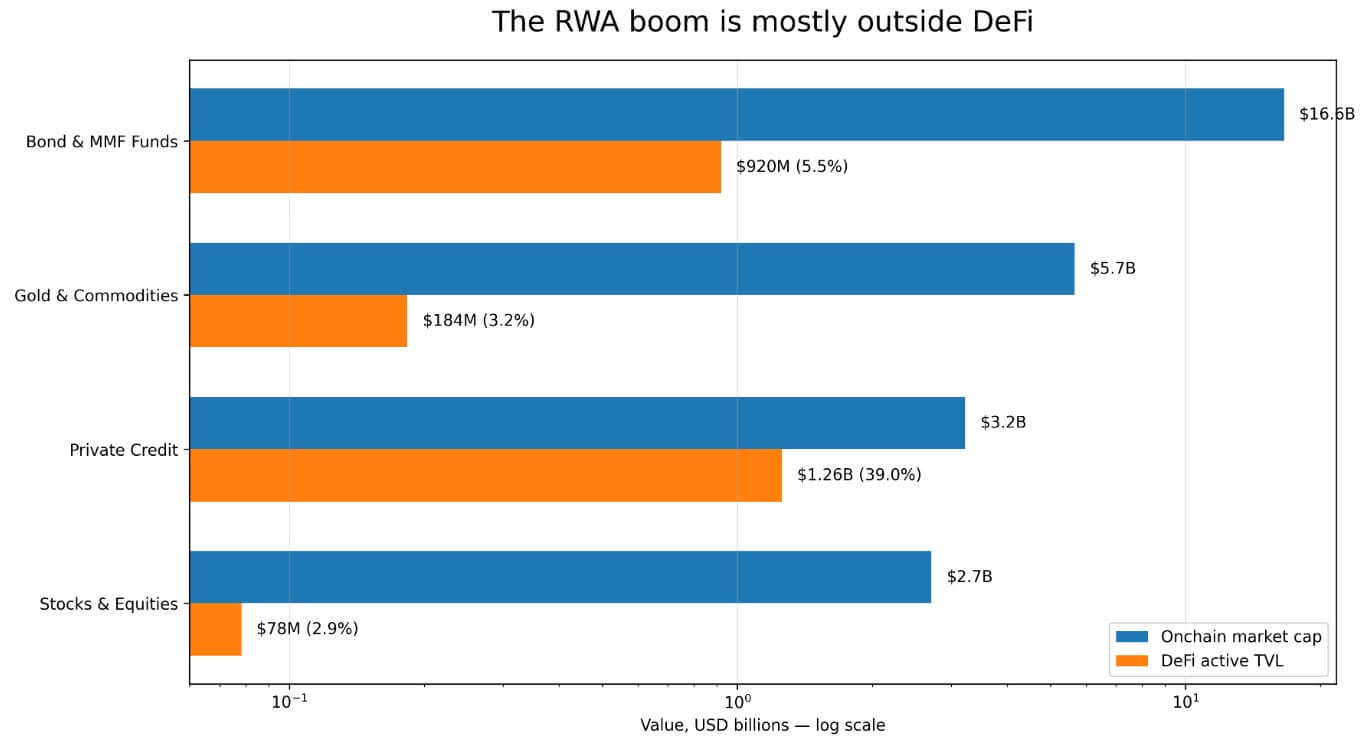
The rest of the tokenized real-world assets market sits outside the lending markets and collateral vaults that make crypto assets composable. Bond and money market funds are the largest single RWA category at over $16.6 billion on-chain, yet they carry only $920 million in DeFi active total value locked (TVL).
Gold and commodities sit at $5.7 billion on-chain against $183.6 million in DeFi, while stocks and equities contribute $2.7 billion on-chain against $78.27 million in DeFi.
Private credit stands apart with $3.226 billion on-chain and $1.257 billion in DeFi active TVL, a 39% ratio, driven by protocols like Maple Finance and Centrifuge that built their products as lending instruments from inception.
Issuers built categories such as Treasury funds, gold, and equities for institutional holding and regulated fund architecture.
Permissioned architecture limits DeFi composability
DefiLlama classifies BlackRock's money market fund, BUIDL, as permissioned and records only $18.9 million in DeFi active TVL for the fund.
IOSCO's November 2025 final report on financial asset tokenization noted that BUIDL created a permissioned system on public blockchains for issuance, custody, secondary trading between allowlisted qualified investors, dividend distribution, and redemption.
Prospective holders must clear a Securitize-managed allowlist, and on-chain transactions carry no legal effect until a transfer agent reconciles them with the off-chain record.
That makes BUIDL a compliance infrastructure that runs on blockchain rails for institutional holding and transfer-agent reconciliation. The fact that the fund's contracts interact only with allowlisted addresses prevents direct deposit into open protocols like Aave or Uniswap without a compliant wrapper in between.
BlackRock's February 2026 Uniswap integration moved a portion of BUIDL onto the platform. Still, Securitize controls the list of eligible institutions and market makers, and access stays restricted to qualified purchasers with at least $5 million in assets.
IOSCO found that secondary trading of tokenized money market funds (MMFs) generally operates this way and concluded that the sector has yet to deliver the promised secondary-market liquidity benefits.
RedStone's March 2026 tokenization report identified that the hardest part of tokenization is handling compliance, identity, transfer restrictions, sanctions, and corporate actions across jurisdictions and chains. That makes Morpho and Aave Horizon the clearest RWA DeFi examples in the current data set.
Every additional compliance constraint a platform builds in makes the asset harder to integrate into DeFi, and issuers of tokenized Treasuries, Treasury funds, and MMFs built those constraints in by design to satisfy their regulated investor base.
| Constraint | What it means | Why it limits DeFi use |
|---|---|---|
| KYC / allowlisting | Only approved wallets can hold or transfer the asset | Open DeFi pools cannot freely accept the token |
| Transfer-agent reconciliation | Onchain movement may need offchain legal confirmation | Smart contracts alone may not finalize ownership |
| Qualified-investor limits | Access is restricted to institutions or high-net-worth buyers | Retail DeFi liquidity is excluded |
| NAV / redemption windows | Fund shares redeem on issuer schedules | Hard to fit real-time AMMs or collateral liquidations |
| Centralized venue trading | Activity occurs on CEXs or issuer platforms | It does not appear in DeFi Active TVL |
The gold and commodities category adds a third dimension to the stack, as CoinGecko data showed that tokenized gold spot volume hit $90.7 billion in the first quarter of 2026, surpassing the full year 2025. Yet centralized exchanges account for the vast majority of spot trading for tokenized assets.
The $183.6 million DeFi active TVL figure for the category reflects activity concentrated on centralized venues, which falls entirely outside DefiLlama's DeFi protocol tracking.

Where the bull case lives
Ondo's USDY crossed $1 billion in TVL in early 2026 and operates across nine blockchains. Ondo Global Markets, which launched in September 2025 to offer tokenized US stocks and ETFs to non-US investors, built its tokens for free transferability and DeFi collateral acceptance, reaching $650 million in TVL and over $12 billion in cumulative trading volume.
RedStone's report counts over $620 million in RWA deposits on Morpho and $423.5 million in total market size on Aave Horizon, two lending protocols that have made RWA collateral a functional product.
These products demonstrate that composability is achievable at the issuance level when designers build for permissionless circulation from the start.
DWF Labs' April 2026 roundtable with participants from Centrifuge, Falcon Finance, and xStocks concluded that the RWA market is bifurcating into two lanes: one for ownership-first, permissioned rails, and another for composability-first designs that combine compliant issuance with secondary-market utility.
Centrifuge's Graham Nelson said that strict allowlisting prevents an asset from entering open pools when every pool participant must be individually onboarded.
Centrifuge's DeRWA approach addresses this by wrapping compliant primary issuance with freer secondary transferability. Falcon Finance's Artem Tolkachev called composability and exit mechanics the bridges between real-world assets and crypto liquidity.
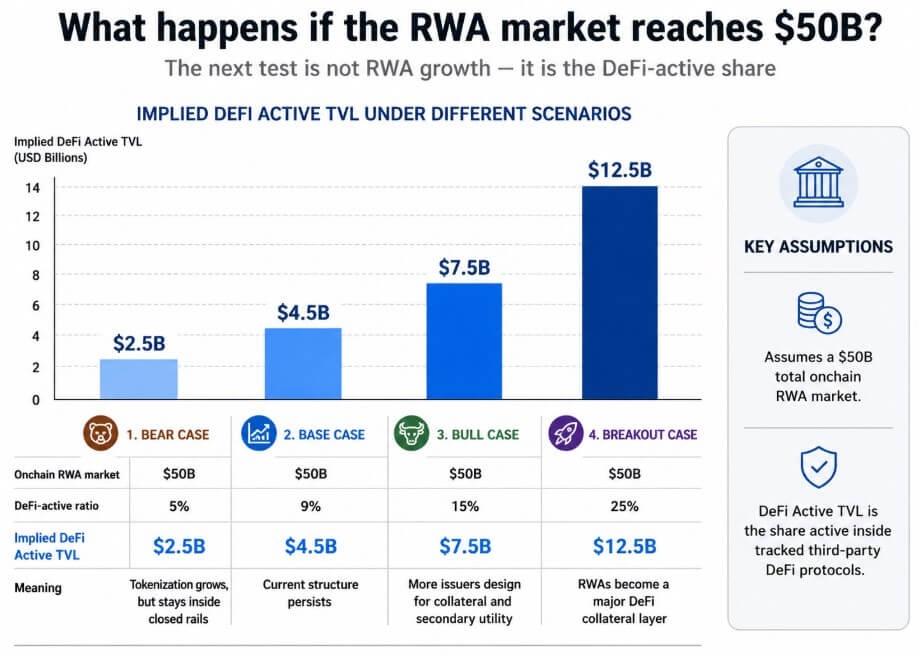
The bull case is that enough of the market moves in this direction to pull the DeFi-active ratio meaningfully above 9% as the total on-chain RWA market approaches $50 billion.
The bear case, in the data
Standard Chartered projects $2 trillion in tokenized assets by 2028 but warns that the boom could consolidate inside bank infrastructure, with open markets capturing little of the growth.
IOSCO's November 2025 report found that tokenized assets still largely rely on conventional financial infrastructure for distribution and secondary trading because of accessibility and liquidity constraints on DLT platforms.
The ECB noted in its April 2026 tokenization research that the lack of common standards can entrench tokenized markets as isolated pools, each with its own compliance framework, settlement layer, and access model, thereby concentrating liquidity within closed networks.
Bond and MMF funds at 5.5%, gold and commodities at 3.2%, and stocks and equities at 2.9% put numbers to that structural separation.
Most tokenized Treasury and MMF products carry minimum investment thresholds, KYC requirements, transfer-agent reconciliation cycles, and NAV-aligned redemption windows that are structurally incompatible with real-time AMM pricing or permissionless collateral vaults.
Regulators required these features, and issuers accepted them.
Two markets, one scoreboard
The $30 billion figure and the $2.47 billion DeFi active TVL figure measure two distinct markets the industry groups under the same RWA label.
One is regulated on-chain finance, consisting of MMFs, Treasury funds, custody rails, and issuer-managed records reconciled by transfer agents. The other is DeFi composability, comprised of assets deposited in lending protocols, used as permissionless collateral, and integrated into automated yield strategies.
Morpho's $620 million in RWA deposits and USDY's nine-chain footprint show the second market has real traction.
For the DeFi-active ratio to surpass 9%, issuers would have to choose a structure that allows permissionless circulation by design instead of the BUIDL architecture, where the compliance structure is the product.
With most of the current $28.56 billion in on-chain market cap in the permissioned camp, tokenized assets still look more like regulated on-chain finance than open DeFi collateral.
The post Why the $30 billion RWA tokenization boom is barely reaching DeFi appeared first on CryptoSlate.