
Altcoin demand meets $18B threat as flows move into RWA perps as just 19% of traders keep alts

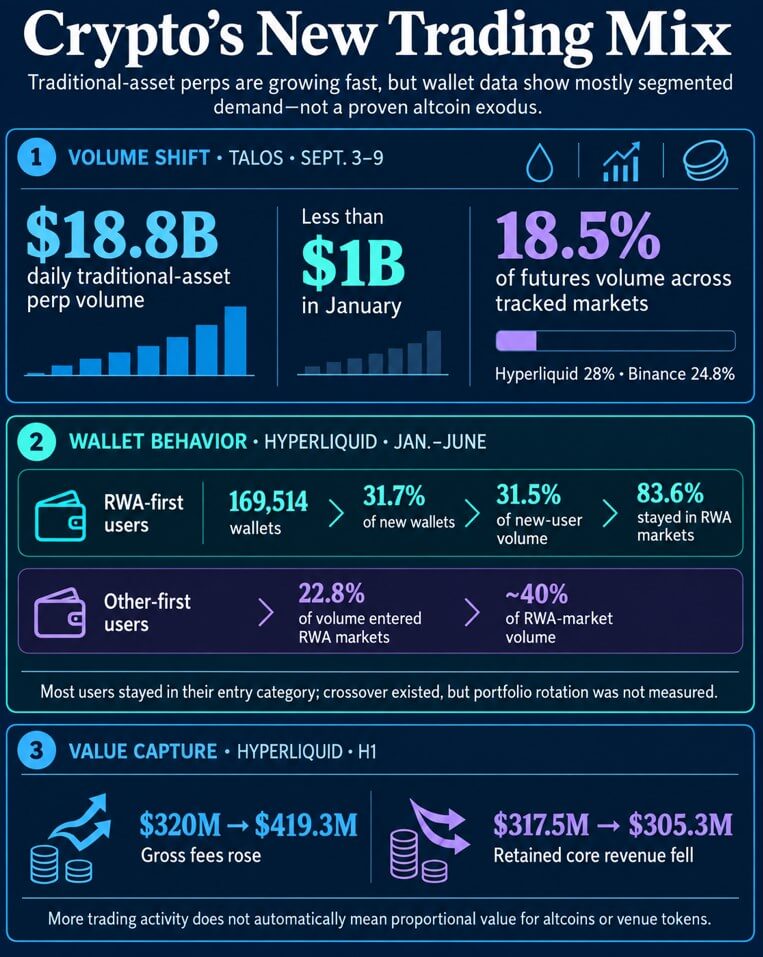
In the markets Talos tracked, daily volume in RWA perpetual futures tied to equities, commodities and indices rose from less than $1 billion in January to $18.8 billion during Sept. 3-9. That represented 18.5% of futures volume across those venues.
Crypto exchanges built their derivatives businesses around perpetual futures, and the same contract structure now wraps exposure to oil, gold, stocks, indices, and pre-IPO companies.
The Talos data show that crypto-perpetual volume declined over the comparison period while total futures activity in its sample remained roughly flat, with traditional-asset contracts filling the volume gap.
The changing product mix creates a real competitive threat for altcoins. Traders no longer need a new token to find leverage, volatility, or a market that stays open around the clock.
Wallet behavior on Hyperliquid points to mostly separate customer groups, with a smaller group trading across both markets.
Hyperliquid’s traders mostly stay in their lanes
Talos found that traditional asset perps represented 28% of futures volume on Hyperliquid and 24.8% on Binance in its sample. Oil led the weekly increase as Brent crossed $100, showing how crypto venues can capture trading around an event unrelated to cryptocurrency.
CoinDesk Research reported that centralized-exchange volume rose 12.7% month over month to $4.29 trillion in August. Spot increased 18.7%, derivatives rose 11.3%, and traditional-asset perpetual volume increased 2.37% to $602 billion.
Both traditional-asset and crypto activity expanded during that month. Substitution could still occur within a specific venue or account, while the aggregate figures show that the two categories can also grow together.
Hyperliquid's HIP-3 framework lets outside builders deploy markets, including contracts linked to stocks and commodities. DefiLlama divided new wallets into RWA-first and “Other-first” cohorts based on the market of their first Hyperliquid trade.
From Jan. 1 through June 30, DefiLlama classified 169,514 new wallets as RWA-first. They represented 31.7% of new wallets and generated $111.6 billion (31.5%) of the trading volume produced by new users.
The economics of this acquisition cohort differed sharply from its share of activity: RWA-first wallets generated only 8.3% of the main trading fees paid by new users in the study.
RWA-first wallets kept 83.6% of their volume in RWA markets, while Other-first wallets, whose first trade was in crypto or another non-RWA market, sent 22.8% of their volume into RWA markets and produced roughly 40% of RWA-market volume.
| Group | Trading behavior | Reader takeaway |
|---|---|---|
| RWA-first wallets | 31.7% of new wallets, 31.5% of new-user volume | Traditional-asset markets attracted a substantial new cohort, though its capital source remains unknown |
| RWA-first wallets | 83.6% of volume stayed in RWA markets | Most traded primarily in the product category they entered through |
| Other-first wallets | Roughly 40% of RWA-market volume | Existing crypto-platform users crossed into traditional assets, with changes to their crypto positions unmeasured |
A DefiLlama follow-up found that 80.9% of RWA-first wallets never crossed into the other market, while 82% of Other-first wallets never crossed into RWA markets.
Cross-market activity increased among the most frequent traders who did cross. The user base divides into three broad groups: RWA-first wallets that mostly stay with those products, crypto-first wallets that mostly stay with crypto, and a smaller high-frequency core that treats both as trading opportunities.
Altcoins face a tougher contest for attention
CryptoRank counted 351 new listings across 10 major centralized exchanges in the second quarter, the fewest since the third quarter of 2023. Tokenized assets accounted for 42 additions, while categories associated with the previous speculative cycle lost momentum.
Gate was responsible for 573 removals, nearly 60% of delistings in the first half. MEXC rarely reported delistings and was effectively excluded from that part of the analysis.
Inside CryptoRank's sample, exchange priorities changed as one venue's cleanup dominated removals and reporting gaps limited the cross-exchange picture. RWA trading cannot be blamed for those delistings.
Binance's tokenized-stock figures also show overlap but do not reveal portfolio rotation. Binance Research reported that 58.5% of early bStocks users also used perpetuals, direct equities, or both.
For altcoin holders, the practical risk is competition at the margin. Market makers have finite balance sheets, exchanges have limited promotional capacity, and traders have limited attention. Familiar stocks and commodities now compete with them inside the same apps and collateral systems.
Altcoins have a new competitor for speculative demand. Another example is the HIP-3, which lets outside builders deploy perpetual markets.
Hyperliquid's fee documentation says deployers may retain up to 50% of trading fees generated by their assets. Trading fees directed to the protocol's Assistance Fund are converted automatically into HYPE, Hyperliquid's native token, and the acquired HYPE is burned.
Only a portion of builder-market activity reaches HYPE-related mechanisms. Assistance Fund burns can reduce token supply, while market price still depends on demand, liquidity and the broader market.
Activity and retained economics can move apart
The divergence appeared in first-half figures calculated by 21Shares, which estimated that Hyperliquid's gross fees rose from $320 million in the first half of 2025 to $419.3 million in the first half of 2026. Its measure of core protocol revenue, the fee share flowing back to the platform treasury, fell from $317.5 million to $305.3 million.
Gross fees and core revenue moved in opposite directions as builder-deployed markets captured a larger share of activity.
Crypto perps led the next monthly expansion, as Hyperliquid's total open interest rose from $6.6 billion to $8.8 billion in September. Meanwhile, HIP-3's share declined from 34% to 25%.
Traditional asset trading can fill a crypto-volume gap in one period and grow alongside crypto in another. It can bring in new wallets, give existing users more products, and create fee streams divided among the protocol, builders, and token-linked mechanisms, making exchanges less dependent on crypto's cycles.
For altcoins, the outcome is more ambiguous. Crypto's trading rails can thrive even when demand for the assets that built them grows more slowly.
The post Altcoin demand meets $18B threat as flows move into RWA perps as just 19% of traders keep alts appeared first on CryptoSlate.