
As foreign investors dump $29 billion in Treasury bills, Washington pivots to stablecoin issuers to back US debt
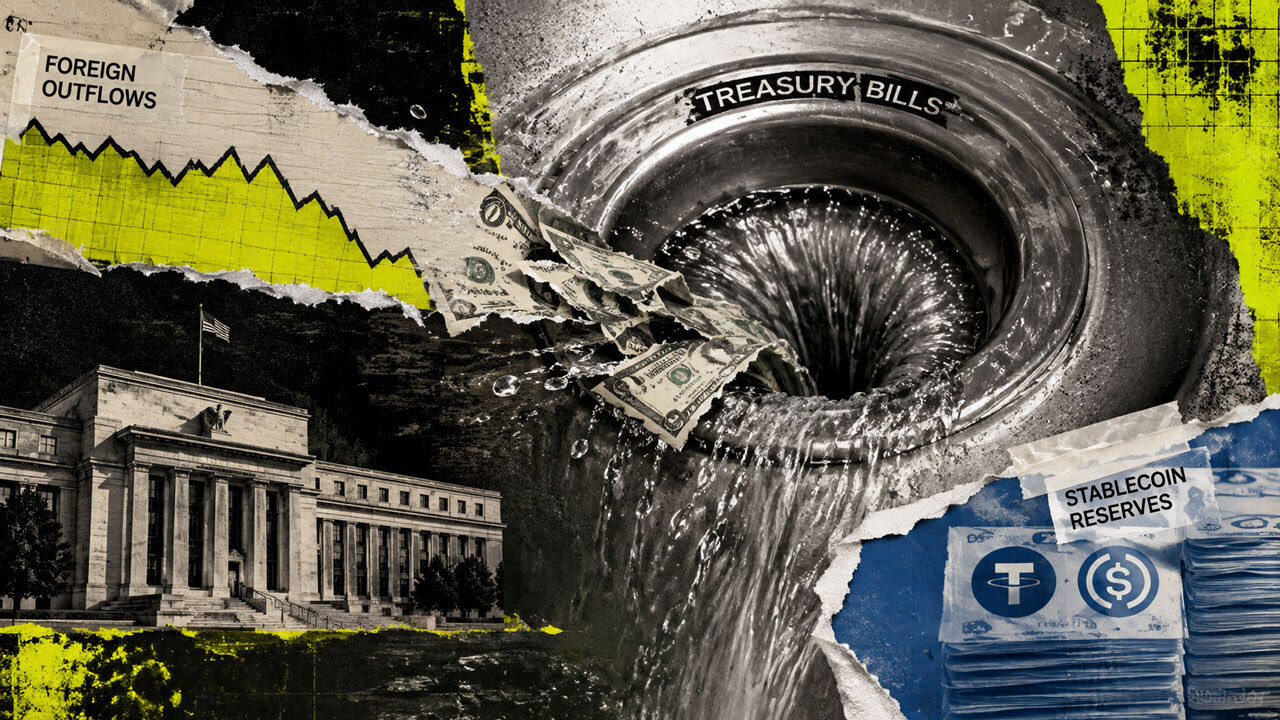
Foreign investors sent a net $133.5 billion into US financial markets in June. During the same month, they sold $29 billion of Treasury bills.
Those numbers describe two different tides in the same month. Most of the incoming money went into US stocks, while demand for government debt was much weaker. Foreign buyers purchased $181.4 billion of US equities and only $6.8 billion of long-term Treasuries. At the short end, they reduced the bills commonly used as a place to park cash.
That split helps explain why stablecoins have become part of Washington's debt strategy. Issuers such as Tether and Circle keep much of the money backing their tokens in Treasury bills and closely related assets. If foreign buyers keep reducing their bill holdings, a larger stablecoin market could provide another, and potentially an equally large source of demand. June's data show that the sector already has plenty of scale, while recent token issuance was far too small to explain the $29 billion sale.
Foreign investors wanted stocks more than cash-like debt
The Treasury International Capital report, usually called TIC, is a monthly record of money moving between the United States and the rest of the world. It combines purchases of securities with shorter-term banking flows, so the headline total can hide very different decisions underneath it.
Here is the simplest way to read June.
| What foreign investors did in June | Net amount |
|---|---|
| Sent money into US securities and banking assets overall | $133.5 billion |
| Bought long-term US securities | $207.1 billion |
| Bought US equities within that long-term total | $181.4 billion |
| Bought long-term Treasury notes and bonds | $6.8 billion |
| Sold short-term Treasury bills | $29.0 billion |
The $181.4 billion equity figure can exceed the $133.5 billion total because the headline nets many incoming and outgoing flows against one another. Treasury-bill sales and $34.4 billion moving out through bank balance-sheet flows offset part of the stock buying. US residents also sent money abroad by purchasing foreign securities.
But while the accounting might be complicated, the basic message isn't: foreign investors kept buying US assets, especially ownership in American companies. However, their appetite for government debt was modest, and they pulled money from its shortest maturity.
A Treasury bill is a US government obligation that matures in one year or less. Because investors get their money back quickly and the market is deep, bills are often treated as a close substitute for cash. Central banks, companies, money-market funds, and stablecoin issuers all use them for that reason.
Foreign holdings of short-term Treasuries fell from about $1.430 trillion in May to $1.400 trillion in June. The June sale equaled roughly 2% of the previous month's holdings. It was also the second monthly reduction in a row: foreign investors sold $43.5 billion in May and $29 billion in June, for a two-month total of about $72.5 billion.
The data can't tell us why those investors sold. The sales could reflect routine cash management or a preference for other assets. The mix points to a selective allocation across US markets: investors bought stocks, trimmed bills and kept the overall flow into the country positive. Treasury's country-level table should also be read carefully because securities are recorded through custodians, which can obscure the owner's true home country.
A stablecoin turns a dollar into demand for Treasury bills
The stablecoin connection is easier to understand through a single purchase. A customer gives an issuer $1 and receives one dollar token. The issuer now owes that customer a dollar at redemption, so it places the backing money in assets that can be sold quickly. Treasury bills fit that job extremely well, because there aren't that many assets in the market that can be sold as quickly and as efficiently as they can.
If the issuer buys a bill, the customer's demand for a digital dollar becomes indirect demand for US government debt. The customer never needs a brokerage account or access to TreasuryDirect, because the stablecoin company handles the reserve investment in the background.
The GENIUS Act formalized this model by requiring regulated payment stablecoins to hold liquid reserves. Treasury's Aug. 17 proposed rule advances the federal framework. Cash, short Treasury obligations, and closely related repurchase agreements receive favored treatment.
CryptoSlate has examined how the law created a federal route for dollar tokens and left reserve design and access to regulators.
Tether shows how large one issuer can become. Its second-quarter attestation listed $114.96 billion of direct Treasury bills and another $25.62 billion in overnight and term repo positions. June's entire $29 billion foreign bill sale was equal to roughly one-quarter of Tether's direct bill portfolio.
That comparison only puts the amounts on the same page. TIC data can't connect the foreign sales to a purchase by Tether or any other issuer.
Circle uses the same basic reserve model for USDC. According to its reserve disclosures, most USDC backing sits in the Circle Reserve Fund, a government money-market fund managed by BlackRock that can hold cash, short-dated Treasuries, and overnight Treasury repo.
Even though Tether and Circle use different structures, both turn demand for digital dollars into demand for cash-like US assets.
Stablecoins could become the buyer Washington wants
It's no wonder why Washington suddenly loves stablecoins so much. Someone outside the United States can hold and transfer a dollar stablecoin without buying a Treasury security directly. The issuer then channels the backing money into Treasury bills or repo. The dollar reaches another user abroad, while reserve demand comes back into the US financial system.
The mechanism only creates fresh Treasury demand when stablecoin circulation expands, or an issuer moves reserves out of another asset. Tether reported $184.6 billion of USDT in circulation at the end of the second quarter, only about $446 million more than at the end of the first. DefiLlama put the entire stablecoin market near $302.1 billion on Aug. 21, down 0.14% over 30 days.
Those figures rule out the simple claim that new token creation absorbed a $29 billion foreign bill sale, as issuers may have rearranged existing reserves. Public figures provide no evidence of a direct handoff from foreign holders to stablecoin companies.
However, the same mechanism can also run backward. When users redeem stablecoins, issuers need cash and may sell bills or allow them to mature. Stablecoins can become a major buyer of government debt while still producing their own periods of buying and selling.
The next TIC release, scheduled for Sept. 16, will cover July. The most important numbers to watch are foreign bill holdings and total stablecoin circulation. A third month of foreign sales beside flat token supply would leave the gap open. Higher stablecoin circulation and larger bill positions in issuer disclosures would show the new buyer becoming more active. Custody reporting may prevent a precise match between the two datasets.
Foreign investors were still buying America in June; they just directed the largest amounts toward stocks and reduced the cash-like government debt held at the short end. Stablecoin issuers already own well over $100 billion of that paper, so they belong in the Treasury-demand discussion. Tether's second-quarter expansion was too small to explain June's sale.
Washington is building rules for a buyer class that could become far more important at the exact maturity where foreign demand softened. That link between digital dollars and government financing is the main reason the $29 billion bill sale deserves attention.
The post As foreign investors dump $29 billion in Treasury bills, Washington pivots to stablecoin issuers to back US debt appeared first on CryptoSlate.