
Bitcoin shattered $80,000 after a $148 billion US liquidity shock failed to break markets

Bitcoin climbed above $80,000 after a $148 billion US Treasury cash build failed to destabilize overnight funding markets.
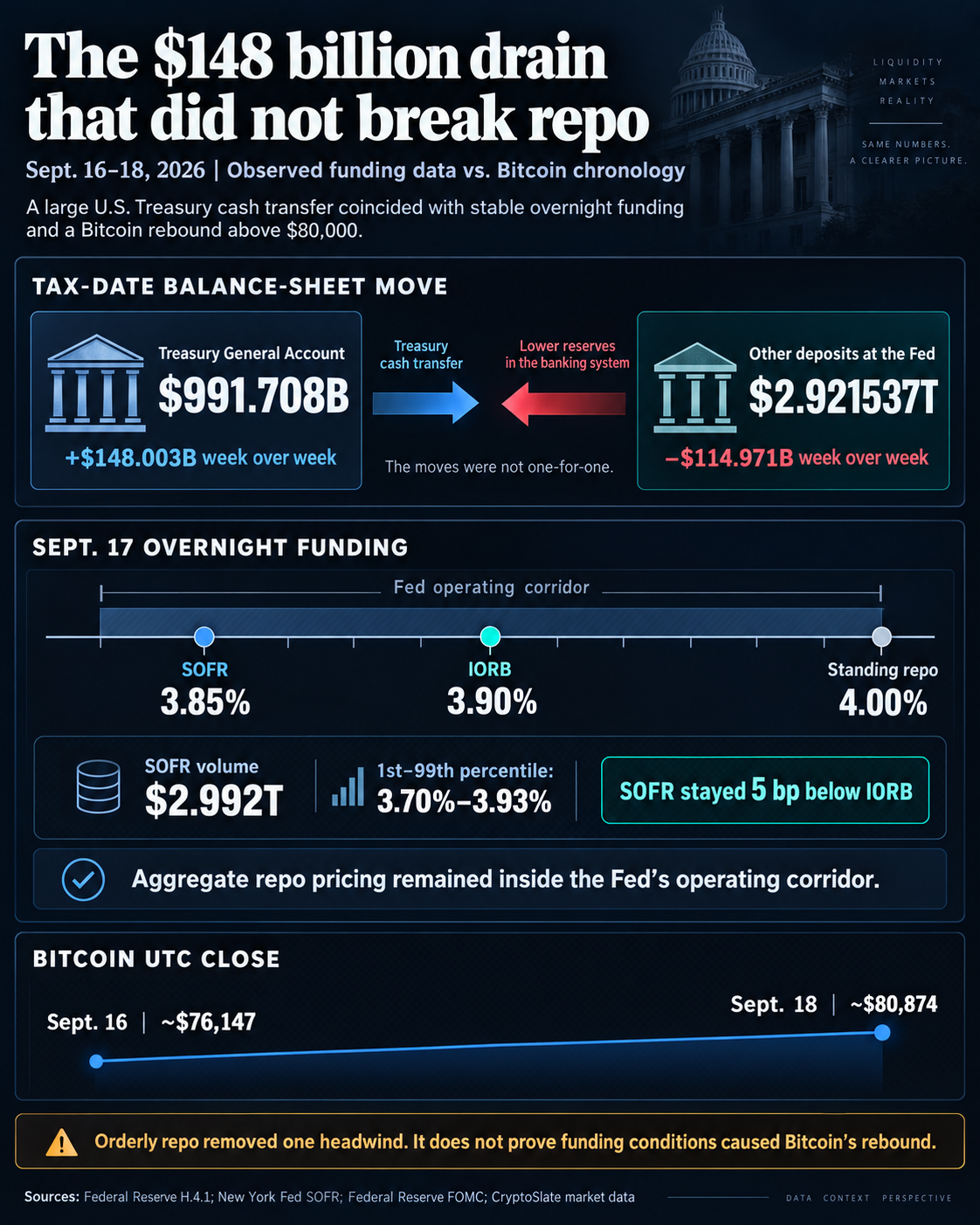
The Treasury General Account rose by $148.003 billion through Sept. 16 to $991.708 billion, Federal Reserve data showed, as tax payments shifted cash into the government’s account at the central bank.
Deposits held by commercial banks at the Fed fell by $114.971 billion over the same period to $2.922 trillion, tightening the pool of reserves available to the financial system. The gap between the two moves shows the Treasury increase did not translate into a one-for-one reserve drain because other balance-sheet flows were also at work.
The transfer had been closely watched because large tax-date inflows into the Treasury can temporarily pull cash from private markets and make short-term funding more expensive. That risk took on added significance after the Fed raised its benchmark interest-rate range by 25 basis points to 3.75% to 4% on Sept. 16.
So far, the strain has remained contained.
The Secured Overnight Financing Rate, the main benchmark for borrowing cash against Treasury securities, printed at 3.85% on Sept. 17 across almost $3 trillion of transactions. That was five basis points below the Fed’s new 3.90% interest rate on reserve balances.
Trading also remained concentrated around the central bank’s policy settings. The 25th and 75th percentiles were 3.83% and 3.90%, while even the 99th percentile reached only 3.93%, seven basis points below the Fed’s 4% standing repo facility rate.
Repo markets absorb the shock
The figures suggest the tax-date withdrawal tightened funding conditions without forcing broad money markets outside the Fed’s operating corridor.
SOFR rose 23 basis points from 3.62% after the Fed’s rate increase took effect, closely tracking the scheduled policy reset. That makes the change in official rates the clearest explanation for most of the repricing, while leaving open the possibility that tax-related cash demand added pressure at the margin.
The absence of a wider funding squeeze removed one potential source of stress for risk assets as Bitcoin recovered from a sharp pullback.
During the period, Bitcoin rose from about $76,147 to more than $80,000. It was trading around $82,000 at press time, according to CryptoSlate data.
The rebound coincided with renewed inflows into spot Bitcoin exchange-traded funds, a technology-led equity rally and weakness in the yen, while the role of short covering remains unresolved.
The funding data provide little evidence that the Treasury transfer itself generated demand for Bitcoin. Instead, they show that one liquidity risk hanging over the market passed without developing into a broader disruption.
That distinction will matter as traders assess whether Bitcoin can extend the recovery. With repo markets still behaving normally, attention shifts back toward ETF demand, positioning and the durability of the broader risk-asset rebound.
A renewed rise in short-term funding costs would quickly change that calculus. For now, the next test is whether fresh buyers continue to support Bitcoin after the temporary tax-date pressure has passed.
The post Bitcoin shattered $80,000 after a $148 billion US liquidity shock failed to break markets appeared first on CryptoSlate.