
Boltz’s shutdown shows the real danger of AI hacking is pushing crypto back into the hands of giant custodians
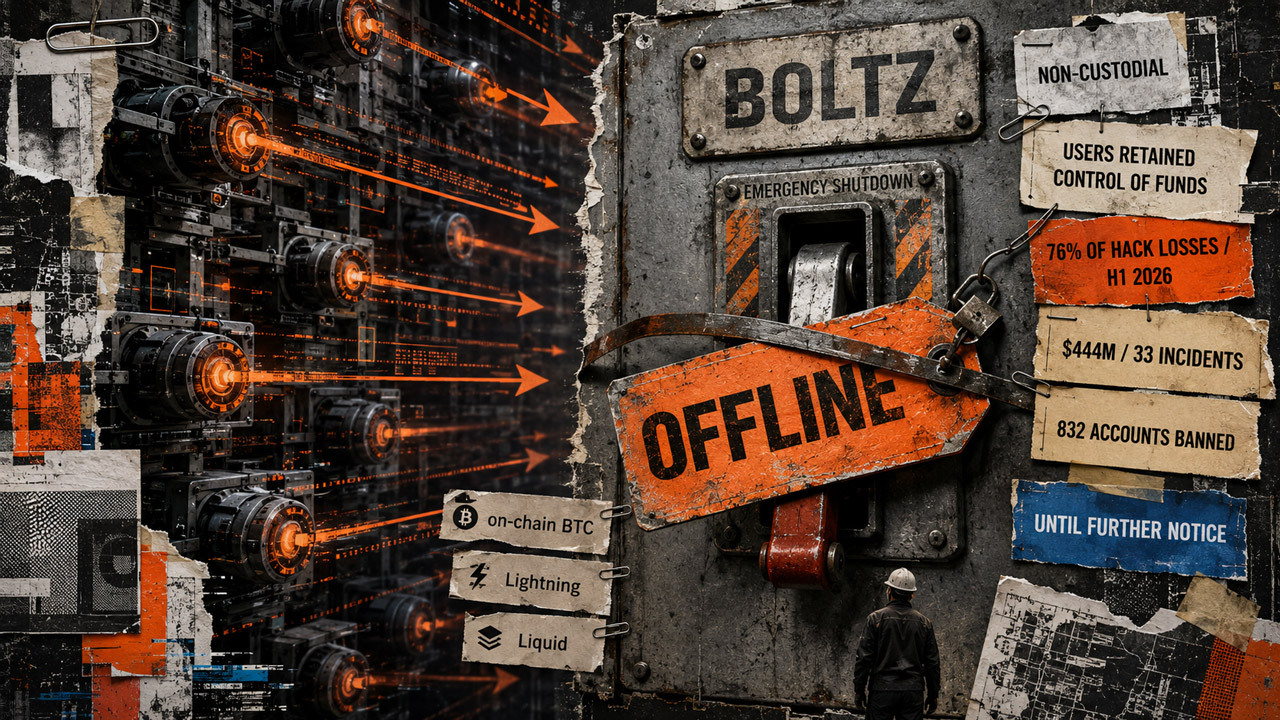
In an Aug. 3 post, Bitcoin bridge Boltz said automated, AI-assisted probing led to several contained exploits before the attack accelerated sharply. Boltz's non-custodial design kept every user's funds safe through months of attacks. Yet the Bitcoin swap service shut down anyway.
Boltz said its team could no longer keep pace, so swaps will remain offline until further notice.
Before the shutdown, Boltz bridged Bitcoin's layers by switching between on-chain BTC, the Lightning Network, and Liquid. Its non-custodial structure meant users retained control of their coins throughout each swap, with a built-in refund path if anything went wrong before settlement.
That structure protected user balances, but keeping the business running was a separate problem. Boltz absorbed the losses from exploits on its own books, then decided the swap product could no longer operate safely.
| Layer | What held up | What broke down |
|---|---|---|
| User custody | Users retained control of funds | Swap service still had to shut down |
| Refund path | Refunds remained available | Normal swap flow stayed disabled |
| Protocol design | Non-custodial structure limited user-fund risk | Exploit losses still hit Boltz directly |
| Business operation | Support and API refunds continued | Product availability became unsustainable |
| Security response | Exploits were contained | Attack pace exceeded team capacity |
A game of cat and mouse
AI's real advantage goes to whoever can automate the entire defensive chain. That chain involves confirming a finding, assessing its severity, building and testing a fix, and shipping it without breaking anything else. Defenders must then watch for the next move.
A small team may not be able to validate and patch vulnerabilities as quickly as attackers can find and exploit them. Boltz's statement indicates that its attackers reached that speed before its defenses did.
Google noted in a July 30 post about Chrome that automated triage now filters noise, reproduces bugs and routes issues to the right owner. The company estimated that the process saves hundreds of developer hours a month.
Large language models generate candidate fixes for most vulnerabilities Chrome finds. Separate AI agents review that work and write tests before a human signs off. That gap between well-funded defense and everyone else is what small teams face.
Anthropic analyzed 832 accounts it had banned for AI-enabled cyber activity between March 2025 and March 2026. Its researchers found attackers increasingly relying on AI to scan targets and collect data.
Google's Threat Intelligence Group has described the same move toward industrial-scale use of generative models in offensive workflows.
CISA moved in the same direction in June, telling federal agencies that AI is helping researchers and attackers find flaws at a similar pace. It pushed the riskiest vulnerabilities toward patch windows measured in days, a sharp break from the usual cycle.
The Open Source Security Foundation is now building tools to triage and validate AI-generated vulnerability reports before they reach a maintainer.
OpenJS has separately warned that a flood of low-quality, AI-written reports can consume maintainer time even when no real vulnerability exists.
Small teams end up fighting on two fronts at once: real automated exploit attempts and automated noise that eats the attention needed to catch them.
| Step in the security chain | Attacker advantage | Defender burden |
|---|---|---|
| Discovery | Scan targets continuously at low cost | Monitor code, infrastructure and dependencies continuously |
| Validation | Only one working exploit needs to succeed | Every credible finding must be checked |
| Triage | Ignore failed attempts | Rank severity without missing a real threat |
| Patch development | Iterate until something breaks | Build a fix that does not create new failures |
| Testing | Move to the next target quickly | Verify the fix across live systems |
| Deployment | Exploit before patch lands | Ship safely without disrupting users |
| Follow-up | Change tactics after each fix | Monitor whether the attacker adapted |
Small teams are bearing the most
That two-front problem is what turns security into a barrier to entry for crypto infrastructure.
Staying safe now takes continuous automated testing, a team large enough to triage the findings, and a fast, safe patch-release process. Teams also need round-the-clock monitoring, external audits and bug bounties. They must be able to shut down one broken component without taking down the whole product.
Smaller teams facing that bill have a handful of options: raise money specifically for security, outsource it, merge with a larger provider, narrow their offerings, or shut down a product.
TRM Labs found that infrastructure and operational compromises accounted for roughly 76% of crypto hack losses in the first half of 2026. These attacks targeted systems, credentials and signing infrastructure, even though they represented only about 15% of incidents.
CertiK identified wallet compromise as the costliest category over the same period, with more than $444 million stolen across 33 incidents. Attackers are moving toward the operational layer, the teams and processes running the systems, and away from the cryptography underneath them.
What Boltz's shutdown could mean
The bull case is that open-source security tooling is catching up fast enough for small teams to keep pace. Shared triage systems and pooled AI defense tools could let a Boltz-sized company automate the same discovery-to-patch pipeline Google uses internally. The challenge is doing so at a scale it can afford.
In that version, AI becomes a force multiplier for defenders too, and small Bitcoin-native services stay viable without matching a tech giant's security budget line for line.
The bear case is that security costs outrun revenue for everyone below a certain size. More AI-assisted probing hits bridges, swaps, wallets and Lightning services faster than small teams can fund the fixes.
That pushes them to narrow their product lines, outsource security entirely, or suspend the riskiest parts of their business, as Boltz just did.
Traffic then drifts toward exchanges, custodians and infrastructure platforms with budgets for machine-speed defense. That would concentrate an industry built to avoid exactly that kind of dependency.
| Scenario | What changes | Likely outcome | Risk for Bitcoin-native services |
|---|---|---|---|
| Bull case | Shared AI defense tools mature | Small teams automate triage and patching affordably | Open-source services remain competitive |
| Base case | Security becomes a larger fixed cost | Teams narrow products and outsource more defense | Innovation slows but does not collapse |
| Bear case | Attack speed outruns small-team budgets | More services suspend high-risk products | Traffic shifts to larger providers |
| Consolidation case | Users prioritize availability over decentralization | Exchanges, custodians and big infrastructure gain share | Dependency returns through the security budget |
| Black swan | Multiple open-source crypto services are targeted at once | Emergency shutdowns spread across the stack | Machine-speed attacks become a centralization shock |
AI has made it cheaper to design and launch open financial software. Boltz's example shows it can make that software more expensive to defend once real users depend on it.
The industry's next competitive test may be whether a team can survive machine-speed probing without shutting its doors.
The post Boltz’s shutdown shows the real danger of AI hacking is pushing crypto back into the hands of giant custodians appeared first on CryptoSlate.