
Cardano proposal slashes fees by 55%, but it comes with a cost for small pools

A new Cardano governance action proposes cutting the minimum from 170 ADA to 75 ADA, this time without the Plutus memory-limit change that brought stake pool operators into the previous ballot.
The proposal drops one voting requirement that stopped the earlier action. Approval is pending, and each pool would still set its own declared fee.
Delegators in a small pool can lose a large share of a thin epoch reward to its fixed charge before their share is calculated. Meanwhile, operators rely on that charge for income, and those with little delegated stake already face uneven block production.
A lower floor would give them more room to compete on price, while leaving each operator to decide whether to use it.
A different ballot leaves the reward question open
The earlier action paired the same pool-cost reduction with higher Plutus memory limits. It expired on Sept. 1 after DRep yes votes reached 68.6%, above the 67% threshold, and five of seven Constitutional Committee members voted yes.
Stake pool operator support reached only 34.5% of counted stake, short of the required 51%. The memory-limit component made an SPO vote necessary for the combined action.
The standalone proposal, submitted Sept. 11, changes only minPoolCost. Cardano's parameter glossary classifies that as an economic parameter that needs DRep and Constitutional Committee approval, but no SPO ballot when changed alone.
That is the governance route for this type of change. DRep and committee votes still determine whether it passes, while operators continue debating its economic effects.
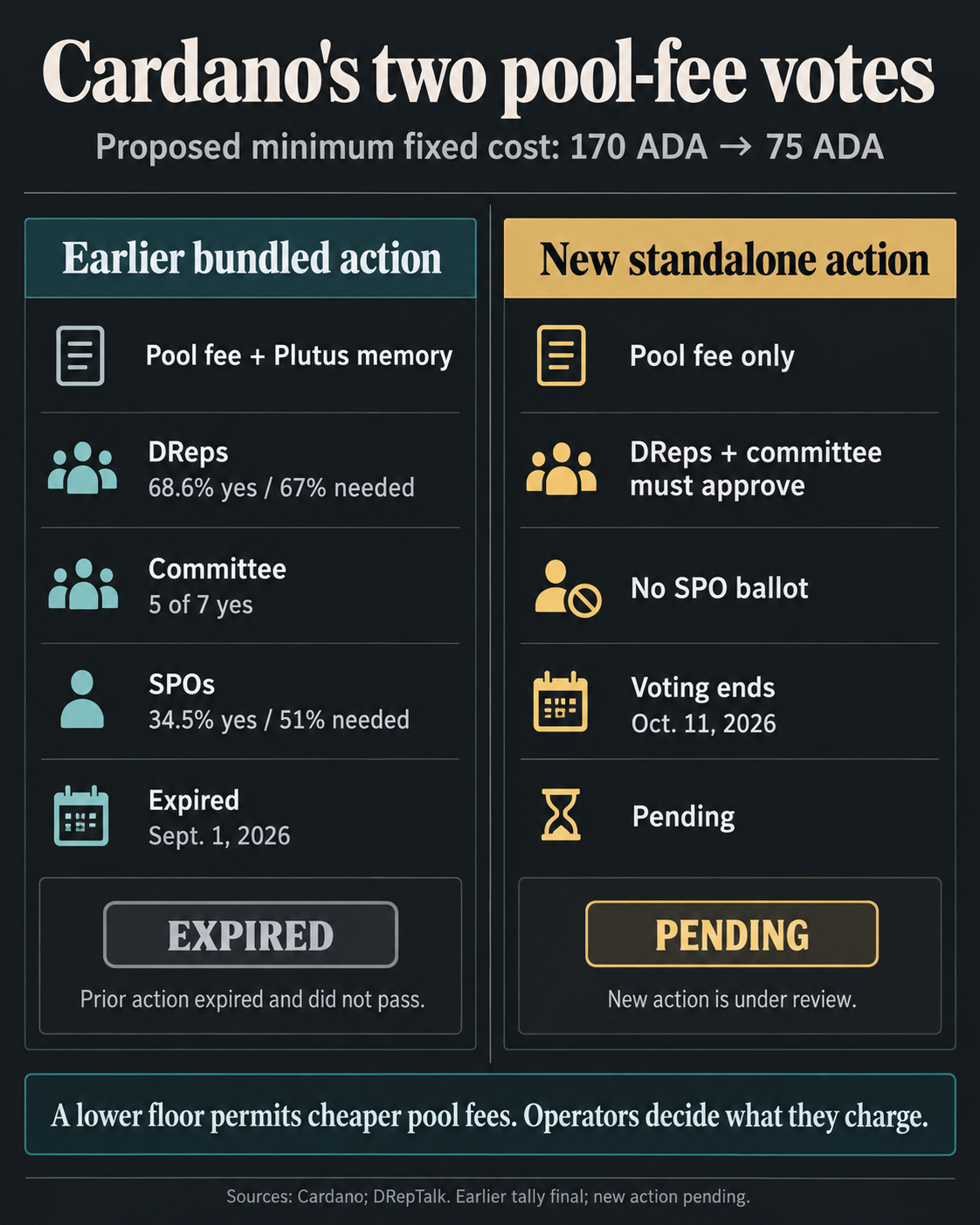
In a cached DRepTalk tally checked Sept. 23, yes votes for the new action represented 11.7% of counted DRep stake, against a 67% threshold. Two of seven committee members had voted yes, or 28.6%, against a 66.7% threshold.
Those figures can change before voting ends in epoch 661 on Oct. 11. A pool's fixed cost is taken from its gross reward each epoch before its margin, and the remainder is distributed across stake. The present mainnet minimum is 170 ADA.
If the proposal passes, an operator could declare 75 ADA, continue charging 170 ADA, or keep a higher fee. Delegators receive a benefit only if a pool with rewards to share actually lowers its charge.
The proposal illustrates the pressure on a small pool with an approximately 300 ADA gross reward from one block. At a 170 ADA fixed cost, about 57% of that reward goes to the fixed charge before margin. At 75 ADA, the share would be 25%.
If an operator charging 170 ADA chose 75 ADA in an epoch with sufficient rewards, 95 ADA more would remain before margin and allocation across stake. Each delegator's gain would depend on stake, margin, and the pool's actual rewards.
The strongest caution comes from how operators reacted to the last floor reduction. An Input Output Research study found that 340 ADA was still the most common declared fixed cost across active pool sizes after Cardano lowered the minimum from 340 to 170 ADA in October 2023.
The 170 ADA fee became a second tier used by smaller challengers. The prior cut expanded pricing options without prompting a network-wide shift to the new minimum. Past fee choices leave the response to a 75 ADA floor uncertain, and the parameter change alone would leave existing declared fees in place.
Small-pool relief has an operator cost
The same study classified pools using a 36-epoch window (epochs 548 through 583) and a viability benchmark tied to 3 million ADA of stake and 5,500 ADA of cumulative rewards. It put 627 active pools in a struggling category below both benchmarks, alongside 246 viable small pools and 741 pools at or above 3 million ADA.
A person or organization can control more than one pool, so pool totals alone cannot show whether ownership is becoming more decentralized.
If a pool lowers its fixed fee, more reward can remain for distribution, but the operator gives up part of a predictable charge. The trade-off is sharpest where block production is irregular and operating income is already thin.
The proposal's author argues that a lower floor could help smaller pools attract stake and describes the change as an interim step toward broader fee reform. Future delegation and operator income will determine whether the lower fee helps those pools become sustainable.
Cardano's wider reward-funding problem also sits outside this vote. Transaction fees covered less than 1% of staking rewards over a 73-epoch period, so changing the floor would alter who may receive a share of rewards in pools that cut their charge.
The immediate test is governance: whether DReps and the committee clear their thresholds by Oct. 11. If they do, the next test is operator behavior.
The measurable benefit for delegators would depend on how many pools actually declare a lower fixed cost, how often those pools earn rewards, and whether the income they retain can support independent operation.
The post Cardano proposal slashes fees by 55%, but it comes with a cost for small pools appeared first on CryptoSlate.