
Circle became a federal trust bank – now lenders warn stablecoins is projected to drain $500 billion
Washington just gave one of the world's largest digital currencies a more official place in the US financial system.
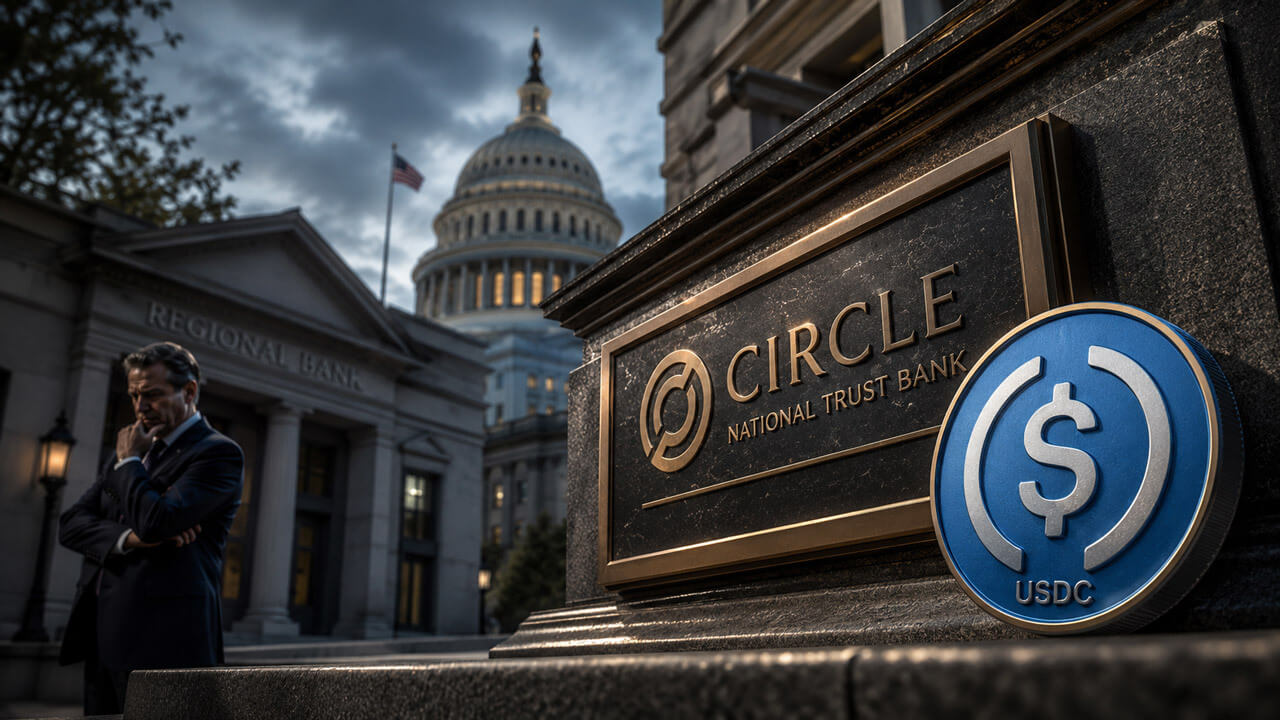
On July 10, Circle won final approval from the Office of the Comptroller of the Currency to open a national trust bank under federal supervision.
Circle called it a major step for USDC, as the approval makes it easier for banks, payment firms, asset managers, and corporate treasury desks to treat USDC as something solid enough to build around.
However, banks see the same approval and draw a different conclusion. In January, Standard Chartered said stablecoins could pull about $500 billion from US bank deposits by the end of 2028. The Federal Reserve has sketched out an even wider range of possible outcomes.
A December 2025 FEDS Note said stablecoin adoption could cut lending by anywhere from $65 billion to $1.26 trillion, depending on the extent of adoption and where issuers keep their reserves.
So Circle now has a federal banking charter, but it isn’t the kind of charter that turns it into a lender with branches, checking accounts, and insured deposits: its new entity is a national trust bank.
Circle’s own announcement says Circle National Trust will open with fiduciary digital-asset custody for Circle and its affiliates, while reserve management stays on the list of future capabilities. The OCC’s conditional approval, issued on December 12, 2025, described the proposed institution as a “trust bank” conducting “trust-company” activities and made clear that the bank itself remains separate from the stablecoin-issuance function.
Circle got a federal trust-bank structure around custody and fiduciary services. It didn't take on the ordinary business of gathering retail deposits and recycling them into mortgages, business loans, and local credit. But that’s still a meaningful victory for the company because federal supervision gives institutional counterparties a clearer regulatory frame for using USDC.
For banks, especially smaller ones, it sharpens a long-running fear. Stablecoins can gain official legitimacy and broader institutional adoption while competing with deposit-taking institutions that still carry the old obligations and the old funding model.
The charter is essentially an upgrade to Circle's credibility. Stablecoins have spent years in an awkward category somewhere between crypto trading infrastructure and serious financial infrastructure, and OCC supervision pushes USDC further into the second category.
That lines up with the broader direction in Washington, as reported in CryptoSlate’s coverage of the GENIUS Act. The policy fight has moved past whether stablecoins should exist, and the main argument now is about how they should be supervised, where they fit in the financial system, and how close they should be allowed to get to deposit-like products.

Circle’s transparency page, updated July 13, showed $72.95 billion in USDC in circulation and reserve components totaling about $73.15 billion. About $11.55 billion was held in bank deposits. The remaining $61.60 billion was held in overnight reverse Treasury repo and Treasury bills with maturities under three months. That reserve structure keeps dollars inside the financial system, but it also channels most of them away from ordinary bank deposit funding.
| USDC reserve mix as of July 13, 2026 | Amount | Share of roughly $73.15B reserve | Why it counts |
|---|---|---|---|
| Other bank deposits | $0.92B | 1.3% | A small slice of the reserve still supports ordinary bank funding |
| Deposits at systemically important institutions | $10.63B | 14.5% | Reserve cash still helps banks here, though it concentrates that support at the largest institutions |
| Overnight reverse Treasury repo | $54.09B | 73.9% | Most of the reserve is parked in short-term government-backed instruments |
| Treasuries under 3 months | $7.51B | 10.3% | More reserve cash is tied to Treasury exposure instead of local credit funding |
| Combined bank deposits | $11.55B | 15.8% | This is the part of the reserve most clearly feeding bank balance sheets |
| Combined repo and T-bills | $61.60B | 84.2% | This is the part that helps explain why stablecoins can reshape bank funding without erasing system-wide dollars |
Circle now changes who funds the loans
The usual shorthand says stablecoins pull money out of banks, but that's not exactly how it works.
A customer can withdraw $1,000 from a regional bank and use it to buy USDC. Circle then places the reserve behind that USDC in cash, repo, or Treasury bills. The seller of those Treasury bills can end up with a deposit at another bank. So the dollars are still in the system; it's just the funding that has moved.
However, that's also the main issue the banks have with stablecoins.
A regional lender doesn’t make loans based on national dollar totals, but on the deposits it can actually keep. If those balances migrate to a giant institution, a Treasury-heavy reserve structure, or some other short-term parking place, the local bank loses a cheap and stable funding source. That's how a stablecoin can change credit conditions even when the aggregate stock of dollars barely changes.
The December 2025 FEDS Note treats the issue as a funding problem rather than a culture-war fight between bankers and crypto companies. The paper shows that the outcome depends on three basic things: where stablecoin demand comes from, what users are giving up when they buy stablecoins, and where issuers place the reserve.
Its lending estimates range from $65 billion to $141 billion in a low-adoption case, $190 billion to $408 billion in a moderate case, and $600 billion to $1.26 trillion in a high-adoption case that assumes issuers gain access to Federal Reserve master accounts.
That range is so wide because the transmission mechanism is wide. Stablecoins can change the composition of funding long before they produce any dramatic change in the quantity of dollars. For community and regional banks, that composition is the whole game. Deposits that move into a systemically important bank or into a reserve structure dominated by repo and Treasury bills still exist, but they stop working as low-cost funding for local lenders.
Circle’s own reserve mix makes the pressure easy to see. Roughly 84% of the reserve was held in repo and short-dated Treasuries as of July 13, while about 16% was held in bank deposits. That's the sort of structure a stablecoin issuer would want after the 2023 USDC shock tied to Silicon Valley Bank, as it emphasizes liquidity, short duration, and assets that can be defended easily under stress.
But from the point of view of a small lender, that structure means transactional balances are being pulled away from relationship banking and redirected toward government-backed reserve assets.
That shift also affects credit. A smaller bank that loses deposits has a limited number of choices. It can pay more to keep depositors, which compresses margins. It can replace the funding in wholesale markets, which is usually more expensive and less stable. It can shrink balance-sheet growth, or it can lend less.
That's why the stablecoin debate is, at its core, a debate about credit. As stablecoins get easier to use, deposits get harder to keep, and as deposits get harder to keep, credit gets harder to supply.
Yield on stablecoins only makes this a more complicated issue for banks. A stablecoin used mainly for payments already competes with ordinary transaction balances because it offers speed, portability, and round-the-clock settlement. Add third-party rewards, exchange incentives, or adjacent tokenized cash products, and the product starts to compete with savings, too.
CryptoSlate’s coverage of the GENIUS Act already scratched the surface of how big a policy concern this could become. We're now seeing banks and regulators wondering how close a private digital dollar should be allowed to get to a bank deposit before regulators decide it should be treated like one.
Banks often compare stablecoins with money-market funds, and the Federal Reserve’s May 2026 follow-up note shows why. Stablecoins move on programmable, cross-border rails with instant settlement. They can spread through digital platforms much faster than earlier deposit competitors. They also have an international dimension because foreign demand for dollar stablecoins can offset some domestic outflows if reserve cash stays in US banks.
Banks already understand the threat well enough to start building tokenized deposits and bank-backed stablecoins of their own. That is what an industry does when it sees a new product category coming directly at its funding base.
Circle’s charter gave its institutional counterparties a stronger reason to see USDC as something they could integrate into custody, settlement, and treasury operations without taking the same reputational leap they had to make a few years ago. That doesn't guarantee mass adoption, and it doesn't settle every open legal issue around stablecoins.
However, it does make the next stage easier to picture. More institutions can now actually use USDC, and more payment and settlement volume can move through a privately issued digital dollar with stronger federal backing than before.
Better supervised dollar infrastructure can deepen liquidity, widen usage, and make onchain dollars more useful in ordinary financial activity. CryptoSlate’s recent coverage of stablecoin demand and payment growth has already pointed in that direction.
But the banks' point of view is much different. One sector’s improved settlement rail can weaken another sector’s deposit franchise.
Circle’s OCC approval is therefore much bigger than a regulatory milestone for one issuer. It's a sign of where the US wants stablecoins to go.
Washington is no longer treating them as a temporary byproduct of crypto trading, and it's giving at least some of them a path into federal supervision, even as banks keep warning that the same products can chip away at the funding base behind local credit.
The old legitimacy fight is fading. The harder fight, over who holds the dollars and who loses the lending power attached to those dollars, is just getting started.
The post Circle became a federal trust bank – now lenders warn stablecoins is projected to drain $500 billion appeared first on CryptoSlate.