
Hoskinson says Vitalik’s AI warning could delay the internet’s quantum defenses
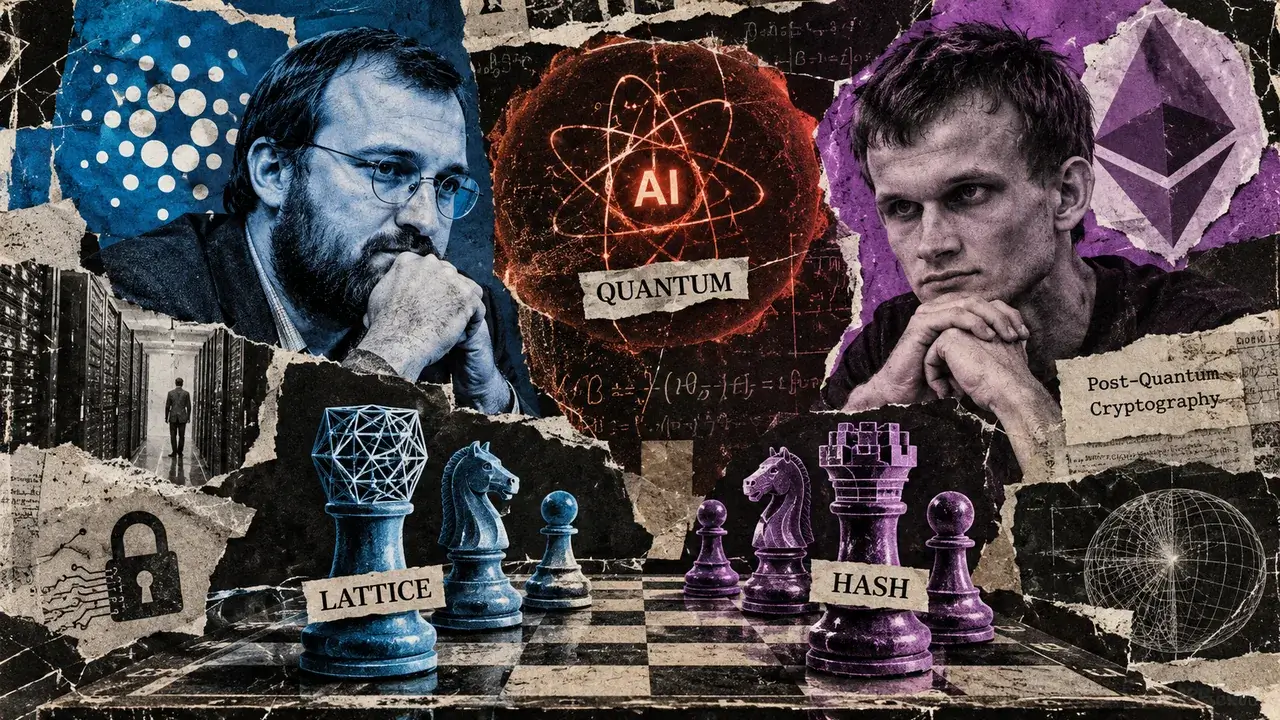
Cardano founder Charles Hoskinson accused Vitalik Buterin of undermining quantum-resistant cryptography with speculative warnings about AI-driven mathematical breakthroughs.
In an Oct. 9 post, Hoskinson challenged the Ethereum co-founder's skepticism toward lattice-based cryptography, arguing that decades of security research had already accounted for the technology's known weaknesses.
He warned that encouraging developers to abandon established approaches could slow the adoption of protections already being deployed across internet infrastructure, leaving systems exposed to future quantum attacks.
The criticism follows Buterin's warning that AI-assisted mathematical discoveries could weaken cryptography designed to resist quantum computers.
Buterin said Ethereum's long-term “lean” roadmap has moved toward hash-based signatures and proofs, avoiding lattice-based designs.
Hoskinson rejected that reasoning, accusing Buterin of being too invested in Ethereum's existing research direction to reconsider its approach.
“The case against lattices is the GNFS story, a.k.a. a hunch about ‘structure,' and a multiplier pulled out of thin air,” Hoskinson wrote.
The dispute concerns post-quantum alternatives to the elliptic-curve signatures used by Bitcoin and Ethereum.
Hoskinson challenges the mathematical case against lattices
Buterin's concern draws partly on the history of integer factorization, where mathematical advances such as the general number field sieve dramatically improved techniques for attacking RSA encryption.
He suggested that AI could deliver decades of comparable mathematical progress in a much shorter period, potentially revealing unexpected shortcuts against lattice-based systems.
Hoskinson said the number field sieve emerged from techniques involving arithmetic relationships and smooth numbers, while no comparable mechanism has been demonstrated against the lattice problems underpinning modern post-quantum standards.
The Cardano founder pointed to more than four decades of research, including advances in lattice reduction and sieving algorithms, that have progressively improved attacks without producing a general breakthrough capable of defeating properly configured systems.
The US National Institute of Standards and Technology standardized ML-KEM for key encapsulation and ML-DSA for digital signatures in 2024. Hoskinson said their security parameters account for those known attacks.
Hoskinson also rejected Buterin's illustrative suggestion that multiplying key sizes by ten might protect public-key encryption against AI-driven mathematical advances.
“Multiply key sizes by ten” is “numerology,” Hoskinson wrote, arguing that security parameters must be adjusted according to measurable improvements in attack algorithms.
A change in attack efficiency might justify moderately larger parameters, while a fundamental mathematical breakthrough could require replacing an algorithm altogether.
Ethereum's hash-based strategy faces its own questions
Hoskinson also challenged the assumption that hash-based cryptography offers greater protection against unforeseen mathematical discoveries.
He cited historical weaknesses in MD5 and SHA-1 as evidence that hash functions can contain exploitable structures, although those failures do not establish vulnerabilities in modern constructions such as SHA-256.
His criticism extended to Poseidon and Poseidon2, hash functions designed for efficient use in zero-knowledge proofs and relevant to Ethereum's longer-term cryptographic research.
The Ethereum Foundation has funded research into Poseidon's resistance to algebraic attacks, including investigations using Gröbner bases and other cryptanalytic methods.
Hoskinson argued that these designs also present potential targets for AI-assisted mathematical discoveries, questioning why lattice-based systems should face greater skepticism.
Hash-based signatures can provide quantum-resistant transaction authorization. Lattice techniques also support key encapsulation for encryption and other advanced cryptographic constructions.
Abandoning lattice research could therefore limit options available to developers building privacy systems, secure communications, and other applications requiring those capabilities.
The post Hoskinson says Vitalik’s AI warning could delay the internet’s quantum defenses appeared first on CryptoSlate.