
How XRP could still break its all-time high and climb 170% this year

XRP has moved from a deleveraging panic to a fragile base-building phase, and the question of when the next all-time high will return hinges on catalysts that have yet to show up in price.
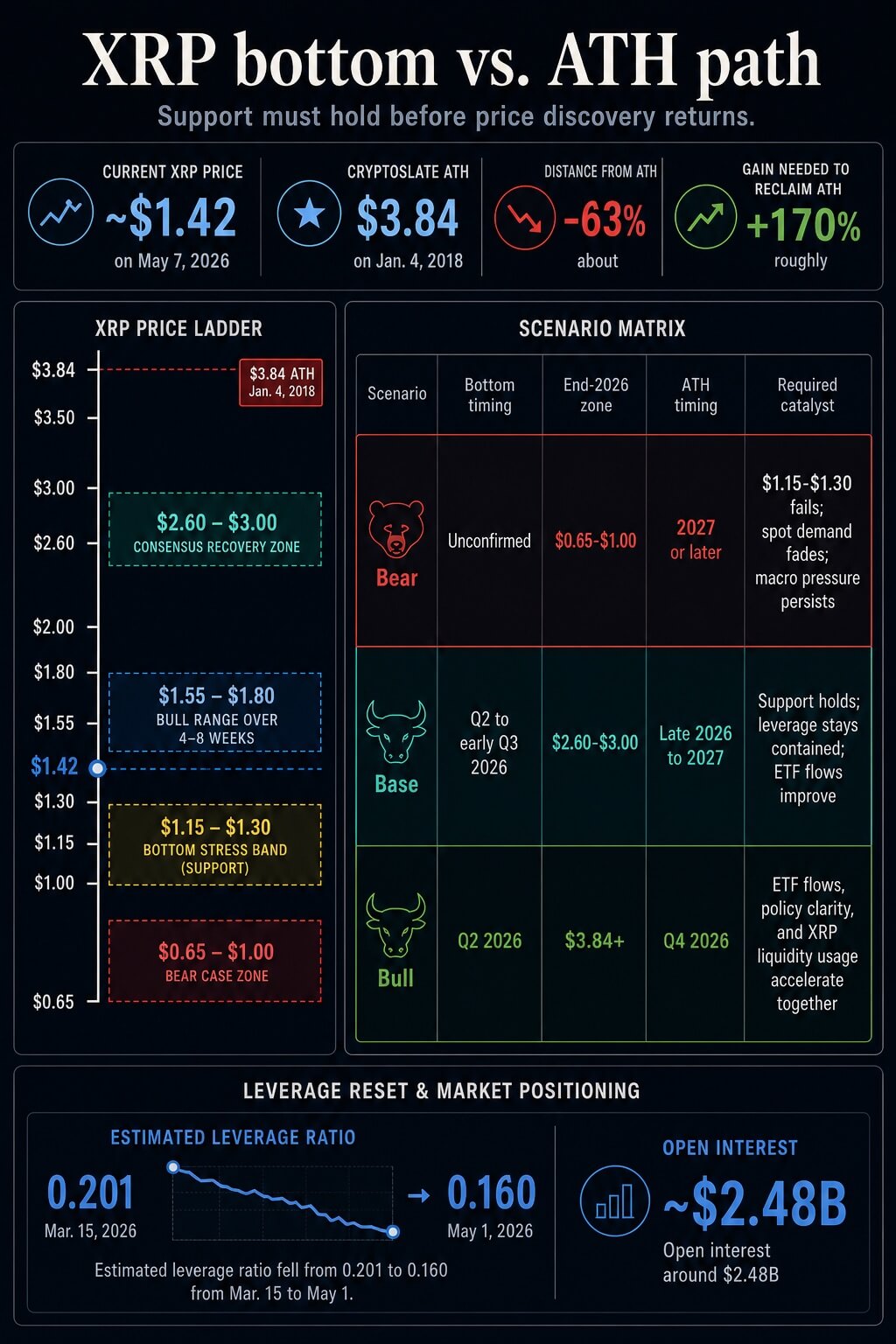
The asset trades around $1.42 on CryptoSlate's live XRP page today, May 7, with a market value near $87.5 billion, roughly $2.8 billion in 24-hour volume, and 61.8 billion tokens in circulation.
That leaves XRP about 63% below the $3.84 all-time high from Jan. 4, 2018. A return to that record would require a gain of roughly 170% from current levels.
That gap turns the question away from hype and toward timing. Ripple and the XRP Ledger have a stronger institutional story than they had in prior cycles, yet the price still needs buyers who want XRP itself, alongside infrastructure that can settle assets around it.
The setup has two parts: a market bottom can form in Q2 or early Q3 2026 if the low-$1 range holds and macro pressure does not worsen, while a new all-time high is more plausibly a late-2026 to 2027 scenario unless policy, ETF flows, and XRP-mediated liquidity demand line up sooner.
The bottom turns on the support zone
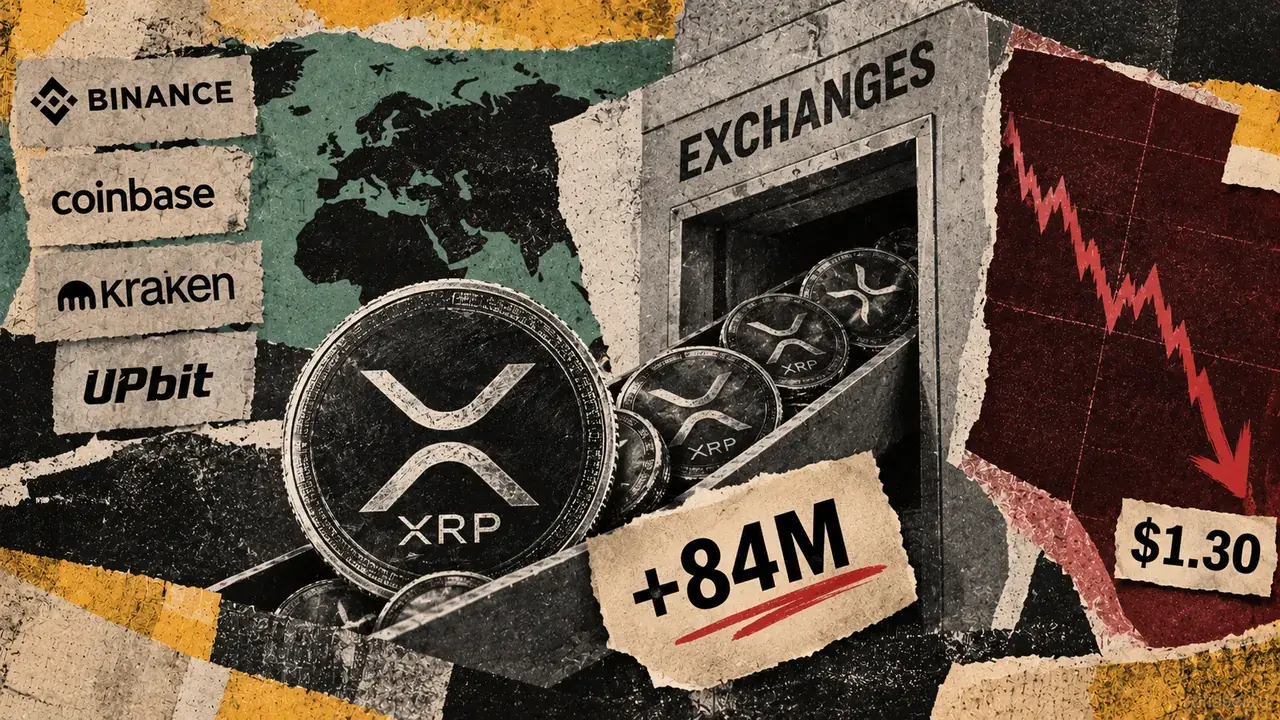
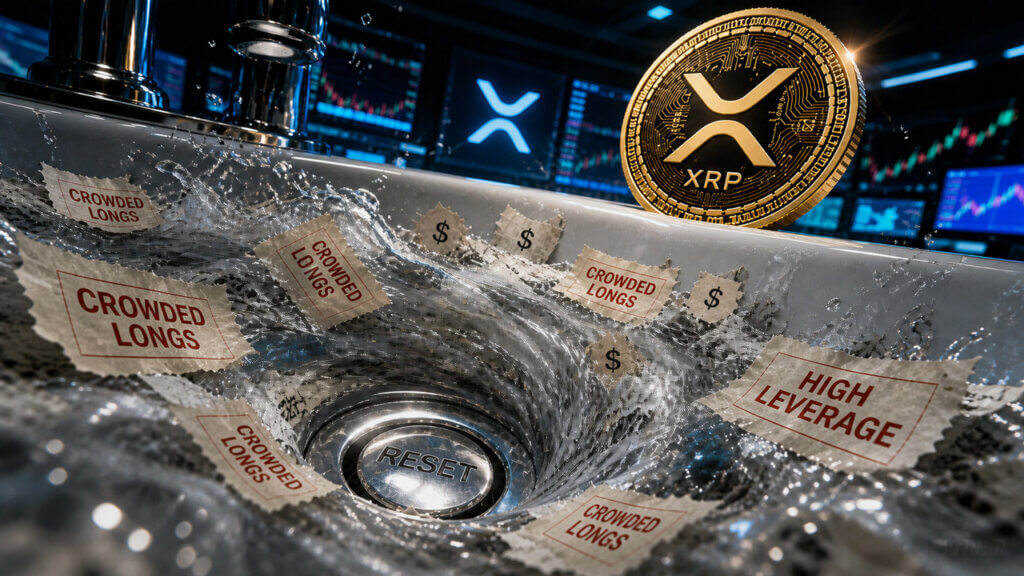
The strongest near-term argument for a bottom is that speculative pressure has already been reduced. XRP's estimated leverage ratio fell from 0.201 to 0.160 between March 15 and May 1, while price held near $1.39 and open interest was around $2.48 billion.
In plain terms, the market has less forced positioning to flush than it carried during the earlier selloff.
Low leverage reduces liquidation risk. Spot demand still has to return.
The same market-structure work laid out a four-to-eight-week bear range of $1.15 to $1.28 and a bull range of $1.55 to $1.80. That puts the first real bottom test in the $1.15 to $1.30 band.
A durable floor would require XRP to absorb a retest of that area, then recover while open interest stays contained relative to price.
The capitulation data point in the same run of CryptoSlate coverage also informs the bottom call. In early April, XRP's decline had already forced late buyers to realize roughly $20 million to $110 million in daily losses during a 55% drawdown.
That is the kind of loss realization that often appears near cycle lows, but a market can purge leverage and still grind lower if macro liquidity deteriorates or if every bounce becomes exit liquidity for trapped holders.
The base case is a process tied to levels and flows. If $1.15 to $1.30 holds through May and June while product flows stabilize and Bitcoin avoids another leg lower, XRP can plausibly mark its cycle low during Q2 or early Q3 2026.
If that band breaks with weak spot volume, the next credible downside markers are $1.00 and, in a more severe bearish scenario, the mid-$0.60s flagged in March analyst commentary.
Confirmation is a market behavior rather than a calendar call. XRP would need buyers to defend the stress band after leverage has reset, then push price back toward the $1.55 to $1.80 bull range without open interest rebuilding too quickly.
That sequence gives the bottom call its guardrails. A hold in the stress band would show the selloff has transferred from forced liquidation to willing accumulation; a break would keep the lower downside markers active.
What it would take to clear $3.84
A new all-time high is a different problem. From $1.42, XRP needs a transition from base-building to sustained allocation.
Three catalysts would have to arrive together for a Q4 2026 record attempt. The first is ETF and product demand that turns from choppy to persistent. XRP-linked products drew $55.39 million in weekly inflows in April.
Later market-structure coverage also showed the flow channel moving in both directions, with a $119.6 million inflow followed by a $56 million outflow and then a $25 million inflow. Year-to-date flows of $147.8 million and assets near $2.6 billion show real institutional interest, while the current scale remains below price-discovery intensity.
The second is policy clarity. The SEC and CFTC's March 17 crypto-asset guidance improved the backdrop for institutional allocation, and CME's listed XRP futures add regulated market infrastructure.
Clarity is an access condition. It still has to translate into spot demand, and it has to arrive while funds have room to add risk.
The third is direct XRP value capture. If banks, funds, market makers, or treasury desks need XRP inventory for routing, bridge liquidity, AMM depth, or collateral-linked activity, the market can justify a more aggressive re-rating.
If they mainly use XRPL infrastructure, stablecoins, or issued assets while holding limited XRP, the token can lag its own ecosystem headlines.
| Case | Likely bottom timing | End-2026 price zone | ATH timing | What has to happen |
|---|---|---|---|---|
| Bear | Unconfirmed | $0.65 to $1.00 | 2027 or later | $1.15-$1.30 fails, spot demand fades, macro pressure persists |
| Base | Q2 to early Q3 2026 | $2.60 to $3.00 | Late 2026 to 2027 | Support holds, leverage stays contained, ETF flows improve |
| Bull | Q2 2026 | $3.84-plus | Q4 2026 | ETF flows, policy clarity, and XRP liquidity usage accelerate together |
| Tail bull | Already forming | Up to $8 in conditional forecasts | Q4 2026 | CLARITY Act progress and a major ETF inflow shock change allocation behavior |
The base case leaves XRP below its CryptoSlate ATH by year-end. The bull case gets it through $3.84, but only with a demand shock stronger than the market is currently pricing.
The $3.84 line is more than a chart marker. It separates recovery from price discovery: below it, XRP is repricing from a stressed base; above it, the market is paying for a new mix of regulated access, product flows, and liquidity usage.
Ripple progress leaves value capture open
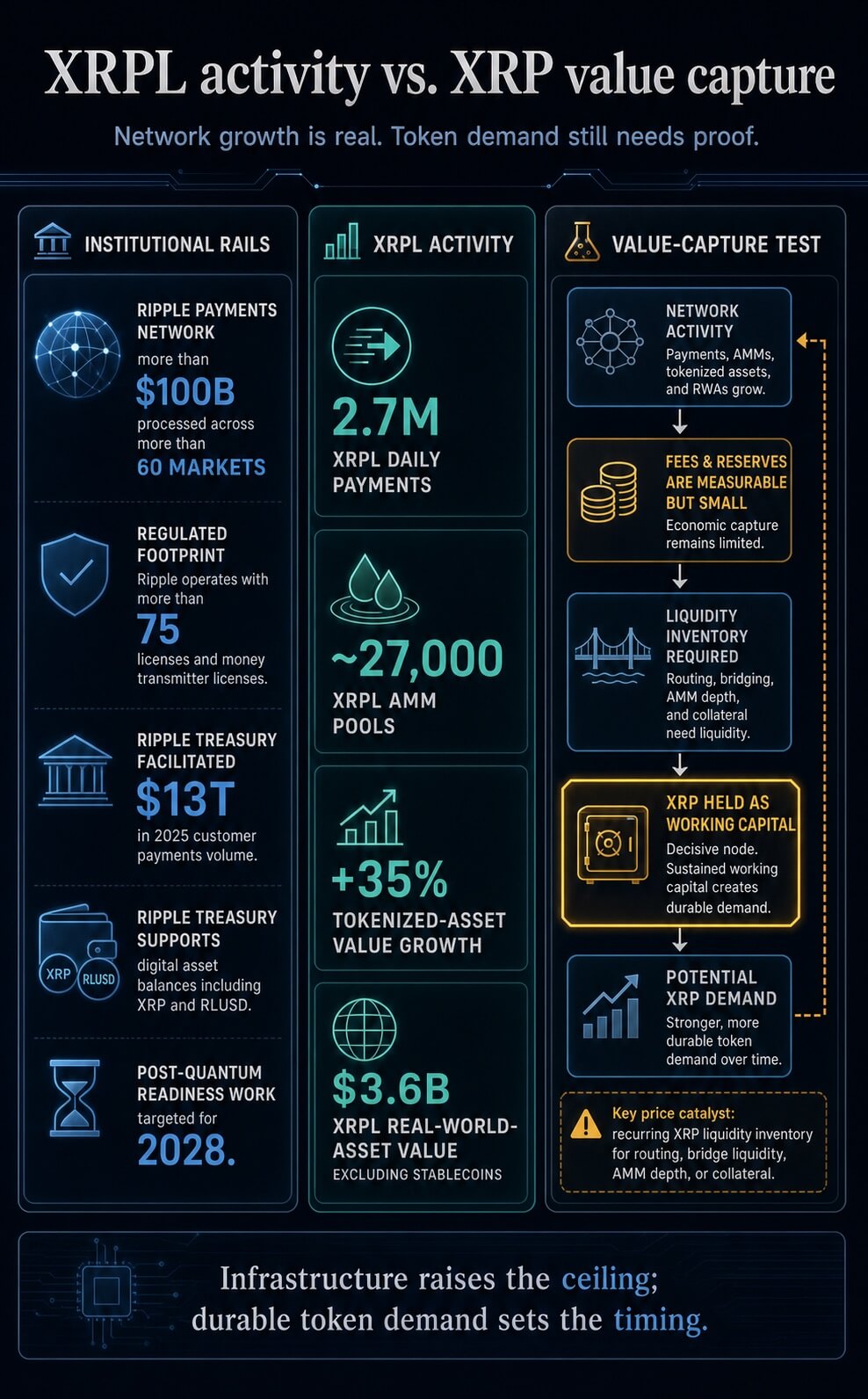
Ripple's development cycle still affects the setup because XRP now trades as more than a lawsuit-era recovery asset. Ripple's payments network has processed more than $100 billion across more than 60 markets and holds more than 75 licenses, including money transmitter licenses.
Ripple Treasury, launched in April, says it facilitated $13 trillion in 2025 customer payment volume and now supports digital asset balances, including XRP and RLUSD, inside treasury workflows.
The XRP Ledger also has a broader institutional roadmap. Ripple's institutional DeFi plan points to multi-purpose tokens, permissioned domains, lending, confidential transfers, and a permissioned DEX as features aimed at regulated finance.
CryptoSlate's XRPL coverage shows that the chain is active, including 2.7 million daily payments, roughly 27,000 AMM pools, and 35% growth in tokenized-asset value, plus $3.6 billion in real-world-asset value excluding stablecoins.

Those improvements are real. They still leave the value-capture question open. CryptoSlate's analysis of XRPL adoption warned that fees and reserves are measurable but small, while represented assets can grow without forcing large XRP inventory demand.
The decisive variable is whether that activity requires market participants to hold, borrow, or route through XRP at scale.
The distinction is critical because XRP's protocol burn and reserve mechanics create only modest direct demand in normal conditions. The larger channel is liquidity inventory: market makers and institutions holding XRP because it gives them better routing, faster settlement, or more efficient access to issued assets.
Ripple's longer-term security planning, including post-quantum readiness work targeted for 2028, can strengthen the institutional credibility stack, yet the price catalyst remains closer to trading desks than engineering roadmaps.
Payment volume and tokenized-asset growth are useful signals. They show a network that institutions can use while the token-demand question remains separate.
On price, the stronger signal would be recurring demand for XRP as bridge inventory, AMM depth, or collateral within those workflows, rather than activity that settles around XRP while leaving the token lightly held.
That is the difference between an ecosystem story and an ATH story. The ecosystem story is already stronger. The ATH story needs proof that activity converts into durable token demand.
End-2026 consensus favors recovery before price discovery
The post-March 2026 forecast set is wide, but its center of gravity sits below a record high. Polymarket-linked XRP thresholds compiled by CoinGecko show higher probabilities at lower levels: about 48.5% for XRP reaching $1, 38% for $2.60, 22.5% for $2.80, 20% for $3.00, and only 13.5% for the $3.20 to $3.40 range.
A Finbold summary of the same market put the highest probability on lower targets, with only 7% odds on $5.
Named projections are similarly split. The Motley Fool cited Standard Chartered's Geoffrey Kendrick cutting a 2026 XRP target to $2.80 from $8 under a stalled-legislation view, while Trevor Jennewine argued XRP could fall to $1 by December.
Kendrick's bull scenario stated that XRP could reach $8 if the CLARITY Act passes and ETF inflows accelerate toward $10 billion.
That makes the practical consensus easier to state: after March 2026, notable views cluster around recovery to $2.60 to $3.00, with $1 still a meaningful bearish outcome and $8 a conditional tail case.
The consensus points to a sharp recovery if the market bottom holds, while price discovery requires more evidence.
| Projection source | Post-March 2026 signal | Implication |
|---|---|---|
| CoinGecko / Polymarket thresholds | Higher odds near $1-$2.80; lower odds above $3 | Market-implied sentiment favors recovery before ATH |
| Finbold summary | Highest probability around $1; only 7% for $5 | Retail prediction-market consensus remains cautious |
| Motley Fool / Standard Chartered citation | $2.80 target in stalled-legislation case | Institutional bull case was reduced without policy acceleration |
| Investing.com / Kendrick scenario | $8 if CLARITY and ETF inflows accelerate | High-end target depends on catalysts awaiting confirmation |
A practical consensus separates probability from possibility. The $2.60 to $3 band is where post-March views begin to converge. The $3.84 ATH sits above that cluster.
The $8 call belongs in a conditional upside scenario tied to legislation and ETF inflows, instead of the base expectation for XRP holders heading into year-end.
That distribution shapes the ATH question because it keeps $3.84 outside the center of the forecast set. A year-end recovery can still be sharp without becoming price discovery, especially if prediction markets continue to assign more weight to lower thresholds than to a full record breakout.
For readers looking for a consensus number, the range is more useful than a single target. The center of gravity after March is recovery toward $2.60 to $3.00, with the record high still dependent on a stronger catalyst stack.
Macro decides whether XRP gets time
The macro backdrop is why the bottom call has to remain conditional. The Federal Reserve held the target range at 3.50% to 3.75% on April 29 and said inflation remained elevated.
The Bureau of Labor Statistics reported the March CPI up 0.9% month over month and 3.3% year over year, with energy up 10.9% on the month.
That mix limits the room for speculative assets to recover without fresh inflows. XRP's past cycles also argue for patience: the asset's ATH is still a 2018 record, and the years since have been shaped by legal, liquidity, and ecosystem-specific repricing rather than a simple four-year repeat.
This cycle has more regulated infrastructure than prior ones, but it also has a market that is more willing to separate infrastructure adoption from token value capture.
The cleanest answer is conditional. XRP's market bottom is most likely forming between Q2 and early Q3 2026 if the $1.15 to $1.30 stress band survives, leverage stays low, and ETF/product flows stop reversing.
A new all-time high can happen in Q4 2026 only if the market receives a combined catalyst from policy, inflows, and real XRP liquidity demand. Without that, the better base case is recovery into year-end, followed by an ATH attempt in late 2026 to 2027.
The levels to watch are simple: $1.15 to $1.30 for the bottom, $2.60 to $3.00 for whether consensus is being repriced, and $3.84 for true price discovery.
Until XRP clears that last level with sustained spot demand, the market is asking whether Ripple's momentum finally belongs to XRP holders.
The post How XRP could still break its all-time high and climb 170% this year appeared first on CryptoSlate.