
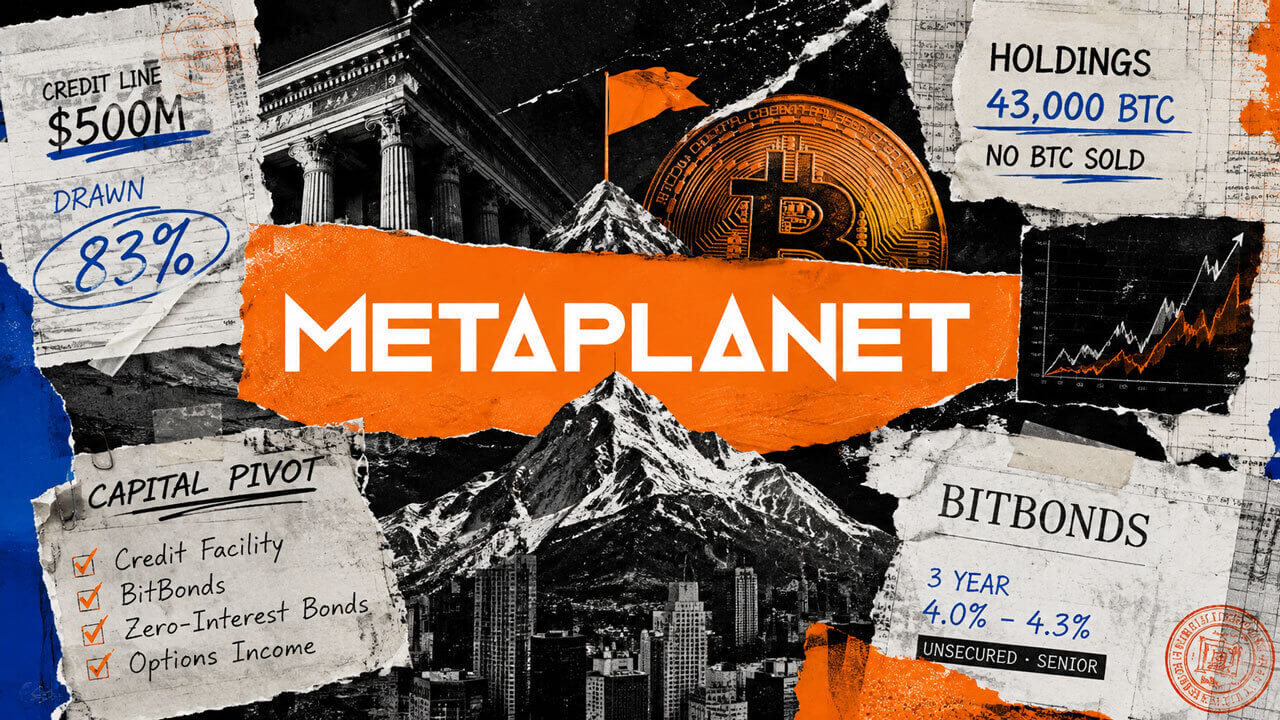
Metaplanet burned through 83% of a $500 million credit line to build 43,000 BTC, and now it wants investors to fund the next leg
Metaplanet moved over 5,000 Bitcoin (worth about $322 million) this week, triggering market speculation that the firm might be liquidating a portion of its corporate reserves.
On Aug. 12, CEO Simon Gerovich shut down the rumor and explained that the transfer was a routine custody operation, with no Bitcoin sold and total holdings unchanged at 43,000 BTC. Network fees for moving the hundreds of millions of dollars in value totaled about $8.
While the physical reserves remain untouched, the company's newly released financial disclosures reveal a sweeping structural pivot beneath the surface.
During the first half of the year, the company recorded a ¥182.77 billion net loss, driven almost entirely by a steep ¥184.30 billion valuation loss reflecting the declining yen-denominated value of its treasury.
Despite generating ¥3.33 billion in operating profit and ¥4.94 billion in revenue over the six months ending June 30, the severe non-cash charge highlights the volatility embedded in the Bitcoin-heavy corporate balance sheet.
The filings show that sustaining the company's purchasing momentum now requires a complex mix of collateralized borrowing, zero-interest bonds and other financing as its equity funding route narrowed.
A stalled equity mechanism forces a capital pivot
The financial engine that powered the company's expansion earlier this year ground to a halt during the second quarter as Bitcoin volatility hit its books and Metaplanet's market valuation weakened relative to the value of its holdings.
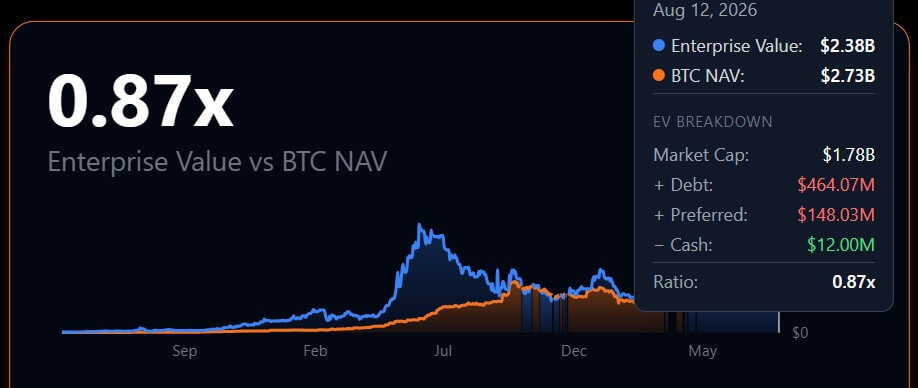
Metaplanet's mNAV, which measures enterprise value divided by the market value of its Bitcoin holdings, hovered around 1.0 and remained below that threshold for most of the six months through June.

Under its stated capital allocation policy, management generally avoids issuing common stock when mNAV drops below 1.0. Operating below that threshold means new share issuance could reduce the amount of Bitcoin attributable to existing shareholders.
Metaplanet raised ¥53.04 billion through third-party common-share allotments on Feb. 13 and March 31 and used the proceeds to acquire Bitcoin.
However, that avenue abruptly closed as the valuation multiple weakened, with the company making no common-share issuances through third-party allotments during the entire second quarter.
Still, the company continued buying Bitcoin anyway. Metaplanet combined an ¥8 billion zero-interest ordinary bond, borrowing under a credit facility, proceeds from previously issued stock acquisition rights and revenue from its options-income business to add 2,823 BTC between April and June.
Across the first half of the year, the company spent ¥99.78 billion acquiring 7,898 BTC, lifting its total holdings to 43,000 BTC without selling a single unit. Bitcoin holdings per 1,000 fully diluted shares increased 9.6% during the period.
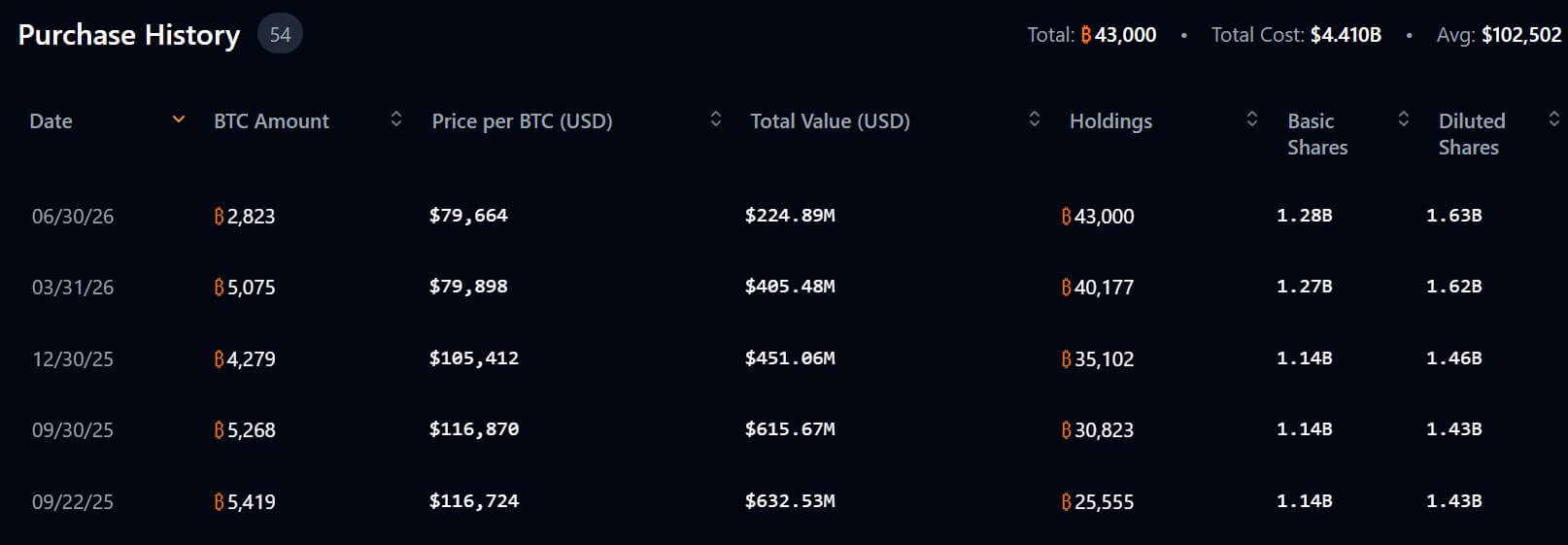
With the traditional equity route suspended, Metaplanet has also drawn heavily against its existing holdings to keep its purchasing streak alive. The growing reliance on credit leaves the firm's financing capacity explicitly tied to the value of an asset that just produced a massive accounting loss.
Total liabilities expanded to ¥77.29 billion at the end of June, up from ¥46.69 billion at the close of 2025. The increase was driven primarily by higher short-term borrowing and ¥8 billion in bonds coming due within one year, while cash and cash equivalents declined to ¥1.09 billion.
The company's primary credit facility requires Bitcoin to be pledged as collateral, granting the lender priority rights over the assets committed under the arrangement. By June 30, Metaplanet had drawn $414 million, representing nearly 83% of the available $500 million facility.
Management did not disclose the exact portion of the 43,000 BTC treasury pledged under the arrangement. The company also recorded ¥1.81 billion in interest expense during the six-month period, reflecting the cost of its expanded financing.
BitBonds create a continuous debt funding channel
With common-share issuance constrained and most of its Bitcoin-backed credit facility already drawn, Metaplanet is now testing the appetite of the corporate credit market for another repeatable source of capital.
On Aug. 13, the company announced the completion of the issuance of its 21st through 24th unsecured ordinary bonds, raising roughly ¥200 million.
Branded as “BitBonds,” the instruments carry maturities of about three years and offer annual coupons ranging from 4.0% to 4.3%.
While the total capital raised represents just over $1.3 million, equivalent to a fraction of the company's daily trading volume, the issuance serves as a structural test.
These bonds are unsecured, unguaranteed, and unrated senior obligations. Holders possess a claim on the company's overall balance sheet, while the debt carries no direct security interest in its Bitcoin reserves. The terms stipulate that investors receive fixed interest and principal repayment without exposure to movements in the price of Bitcoin.
That distinguishes BitBonds from the $500 million facility already being used to fund the company's strategy.
The credit line gives its lender priority rights over pledged Bitcoin, while BitBond investors are lending against Metaplanet's overall creditworthiness and a balance sheet whose principal asset is its Bitcoin treasury.
The framework establishes a continuous issuance program intended to become a core foundation of the company's medium-to-long-term capital structure. Rather than relying solely on previous institutional placements, Metaplanet says the program is designed to broaden its investor base and strengthen its funding capacity.
Metaplanet is using its licensed subsidiary, Metaplanet Securities, to manage applications, allocations and post-issuance administration. This vertical integration allows the company to solicit investors on a series-by-series basis as funding needs arise.

The initial ¥200 million issuance is deliberately small. Metaplanet said it is establishing the issuance, distribution and administration framework needed for future offerings and intends to substantially expand the scale of the program over time.
That expansion could eventually include the appointment of a bond manager and public offerings made under a securities registration statement, moving BitBonds beyond the small-number private placements used for the inaugural issuance.
The bonds also carry liquidity constraints. They do not trade on a public market, meaning investors seeking an early exit would need to negotiate a transaction through the Metaplanet Securities platform. The subsidiary has no obligation to repurchase the securities and may decline to do so.
Metaplanet also retains the ability to redeem outstanding bonds early under predetermined terms, ending future interest payments to holders.
Capitalizing on a shifting macroeconomic environment
The pivot toward fixed-income products arrives as broader macroeconomic shifts in Japan create an opening for corporate debt.
Japan is transitioning to a sustained positive-rate environment while policymakers encourage households to move savings into investment.
Historically, Japanese consumers held cash to protect purchasing power during deflationary periods. With inflation returning, cash no longer provides the same protection it once did.

Metaplanet argues that the domestic market also has limited supply between investment-grade bonds and privately placed debt from smaller companies, creating room for new fixed-income products from listed issuers.
The company intends to position BitBonds within that market by leveraging its status as a Tokyo Stock Exchange-listed company and a balance sheet dominated by Bitcoin, an asset that trades continuously in highly liquid global markets.
For investors, the structure offers fixed-rate payments without direct exposure to Bitcoin price movements.
For Metaplanet, it adds another source of capital as the company works toward its target of holding 100,000 BTC by the end of 2026 while common-share issuance remains constrained at a sub-1.0 mNAV.
The post Metaplanet burned through 83% of a $500 million credit line to build 43,000 BTC, and now it wants investors to fund the next leg appeared first on CryptoSlate.