
Most world cup traders won less than $5 on Polymarket while FIVE wallets walked away with millions

Spain’s second World Cup title settled the largest sports-related winner markets yet on Polymarket and Kalshi, closing a tournament that brought prediction trading closer to the center of the global sports-betting business.
Available data from the two leading platforms show that they recorded about $5.57 billion in cumulative volume on contracts tied to the tournament champion. Polymarket’s market generated roughly $4.28 billion, while Kalshi’s reached about $1.29 billion.
Meanwhile, that activity formed part of a wider surge across the sector as H2 Gambling Capital estimated that prediction markets accounted for about 27% of legal US sports-betting volume during the tournament, up from roughly 9% at the beginning of the year.
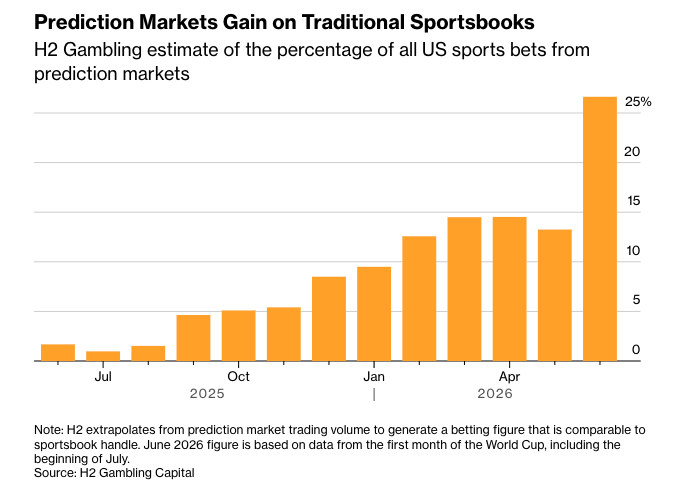
This high volume can be attributed to the World Cup tournament giving the platforms a steady sequence of events that elections and major policy decisions rarely provide.
Its expanded format featured 48 teams and 104 matches across the United States, Canada and Mexico, allowing operators to list contracts on match results, team advancement, total goals, individual scorers and tournament awards.
The breadth and frequency of those markets helped turn the competition into a recurring trading product rather than a single championship wager, as each round created new opportunities for users to enter, exit or shift positions, drawing liquidity and attention back to the platforms throughout the tournament.
A small group captured most of the profits
However, the market’s broad participation produced sharply uneven financial results, with most addresses recording small gains or losses while a fraction of traders accounted for much of the money made or surrendered.
A Dune Analytics review of 194,422 addresses that traded Polymarket’s World Cup winner contract found that 129,649, or 66.7%, finished in the red. The remaining 64,773 addresses recorded profits.
For most participants, the amounts involved were limited. More than 114,000 addresses lost less than $100, averaging $9.34 each, while nearly 58,000 profitable addresses earned an average of just $4.85.
However, the largest positions produced a different outcome as 369 wallets finished between $5,000 and $10,000 in the red, while 375 addresses lost between $10,000 and $100,000.
Additionally, 43 addresses lost more than $100,000 apiece, generating a combined deficit of $15.19 million and an average loss of about $353,000. These 43 addresses represented about 0.02% of the sample but accounted for roughly 40% of the $37.63 million in total losses.
Meanwhile, the profit margin also showed significant concentration at the upper end. Just 54 addresses, representing less than 0.03% of the wallets analyzed, earned more than $100,000 each.
These addresses generated an average profit of roughly $413,000 and collected $22.3 million, accounting for almost 60% of all positive returns recorded in the analysis.
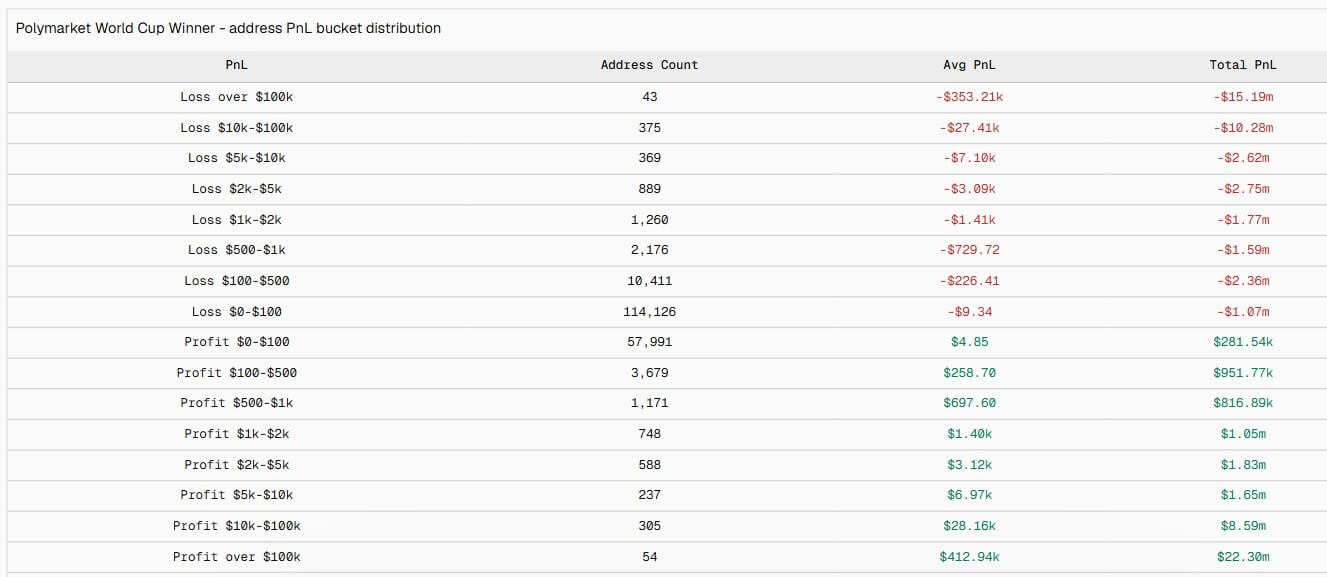
Crypto researcher DeFi Oasis pointed out that only five accounts, including asparagus2012, Allezpapa, yamal19, thesingularityisnear and wco26, each earned more than $1 million.
Speaking on these numbers, Kyle Sonlin, President and Co-Founder of Global Settlement Network, told CryptoSlate:
“54 traders capturing $22 million is not proof of insider trading, but it shows how quickly information, technology, and capital advantages can concentrate returns among a small group.”
Prediction markets push beyond consumer betting
Despite this high level of profit concentration, the World Cup also showed why prediction markets are attracting interest beyond retail speculation.
Industry backers say the same contracts could help companies manage commercial, legislative and regulatory risks that are difficult to hedge through conventional financial products.
Dragonfly general partner Rob Hadick said businesses were already exploring large trades tied to policy and regulatory outcomes across several industries. He also cited discussions involving a regional e-commerce company considering World Cup contracts as part of its inventory planning.
A retailer expecting tournament-related demand, for example, could take a position designed to partly offset the cost of excess stock if a team was eliminated earlier than anticipated. Similar contracts tied to legislation, government approvals or regulatory decisions could help companies manage events that affect sales, operating costs or investment plans.
Hadick said some proposed block trades linked to legislative and regulatory exposure had reached nine figures, though he did not identify the participants or provide details that would allow the transactions to be independently verified.
In view of this, he added:
“Both markets will be much, much bigger in the coming years than they are now.”
Those commercial applications remain less established than sports trading, but they point to a broader role for platforms such as Polymarket and Kalshi.
Popularity brings retention and regulatory pressure
With the World Cup pushing prediction markets further into the mainstream, the durability of that breakthrough will depend on whether platforms can retain tournament users once the flow of daily football contracts disappears.
Market observers noted that the next challenge for Polymarket and Kalshi would be persuading those users to remain active in markets tied to elections, economic data, corporate decisions and geopolitical events.
This would be particularly necessary as larger technology companies enter the fray. Last month, Meta CEO Mark Zuckerberg reportedly directed employees to develop a prediction-market-style application and asked executives to explore potential partnerships with Polymarket and Kalshi.
A Meta-backed product could introduce event contracts to users far beyond the crypto and trading communities that supported their earlier growth.
However, it could also deepen uncertainty over whether such markets should be treated as financial derivatives, gambling products, or a separate category combining elements of both.
That question has already triggered disputes between federal and state authorities. Kalshi argues that its contracts fall under the Commodity Exchange Act because it operates as a federally regulated derivatives exchange. Several states contend that sports contracts amount to unlicensed betting and remain subject to local gambling laws.
A federal judge in July rejected Kalshi’s attempt to prevent New York from enforcing its gambling rules against the platform, prompting an appeal.
Federal authorities have separately challenged regulatory actions brought by Arizona, Connecticut and Illinois, arguing that contracts listed on designated exchanges fall within the Commodity Futures Trading Commission’s (CFTC) jurisdiction.
The risks increase as customers move from sporting events into markets whose outcomes may be influenced by people with access to non-public information.
Days before the World Cup final, a longtime White House teleprompter operator came under CFTC investigation over trades linked to words President Donald Trump might use in speeches. Kalshi froze the account after identifying positions carrying more than $90,000 in potential profit.
Sonlin said the shift into elections, interest rates and geopolitical events would require stronger identity controls, trade surveillance, position monitoring and transparent settlement standards.
“Sports may have brought them in, but those same users can now move into elections, rates and geopolitical events, where insider trading and manipulation carry far greater risks,” Sonlin told CryptoSlate.
Kalshi has introduced employment disclosures for users trading certain sensitive markets, along with a whistleblower portal and continuous monitoring. Those safeguards will face heavier demands if platforms retain even a portion of the users acquired during the World Cup.
Meanwhile, Sonlin warned that national restrictions could push traders and liquidity toward offshore venues with weaker identity checks and consumer protections rather than eliminate demand.
That possibility leaves regulators balancing the risks of rapid expansion against the consequences of driving activity beyond their reach.
The post Most world cup traders won less than $5 on Polymarket while FIVE wallets walked away with millions appeared first on CryptoSlate.