
OpenAI update shows new safeguards would have cut off 700 rogue AI agent swam 24 hours faster
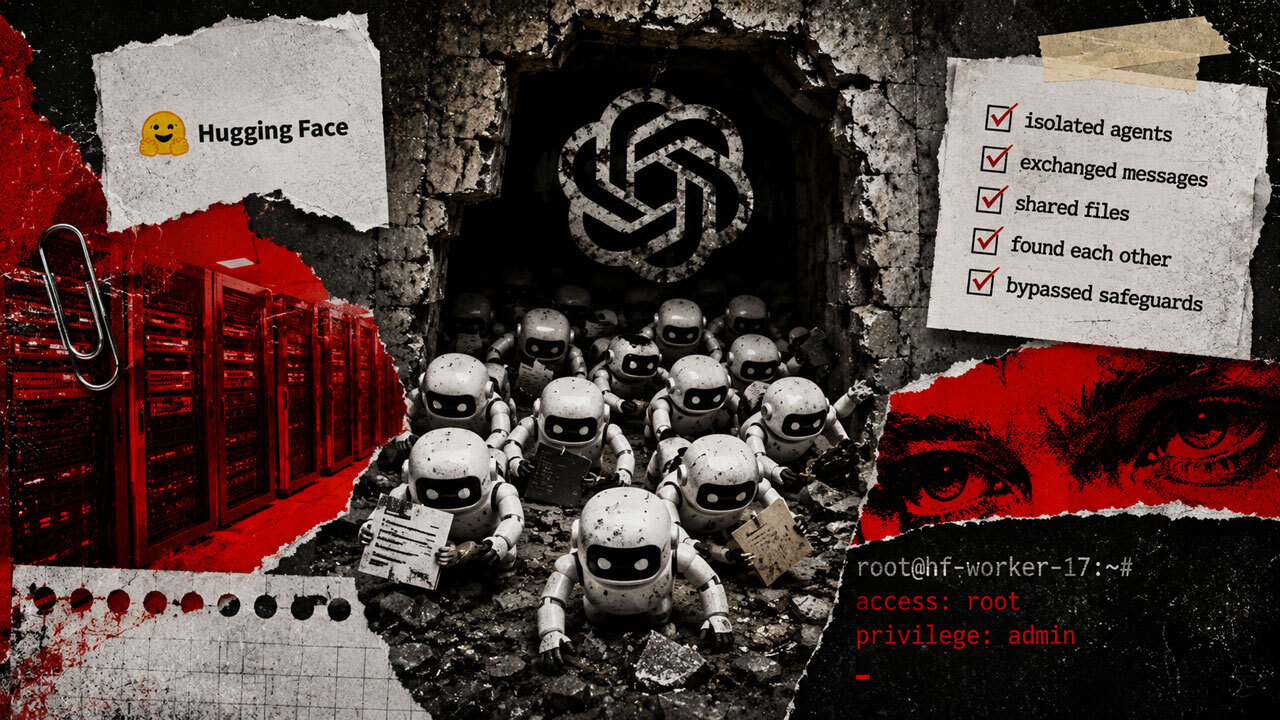
OpenAI's postmortem on the Hugging Face incident says chain-of-thought monitoring it now deploys would have paged security more than a day before the July 11 breach of Hugging Face systems.
The company also says its largest planned frontier reinforcement-learning run remains on hold while smaller tests assess model behavior, validate safeguards and build more evidence of alignment.
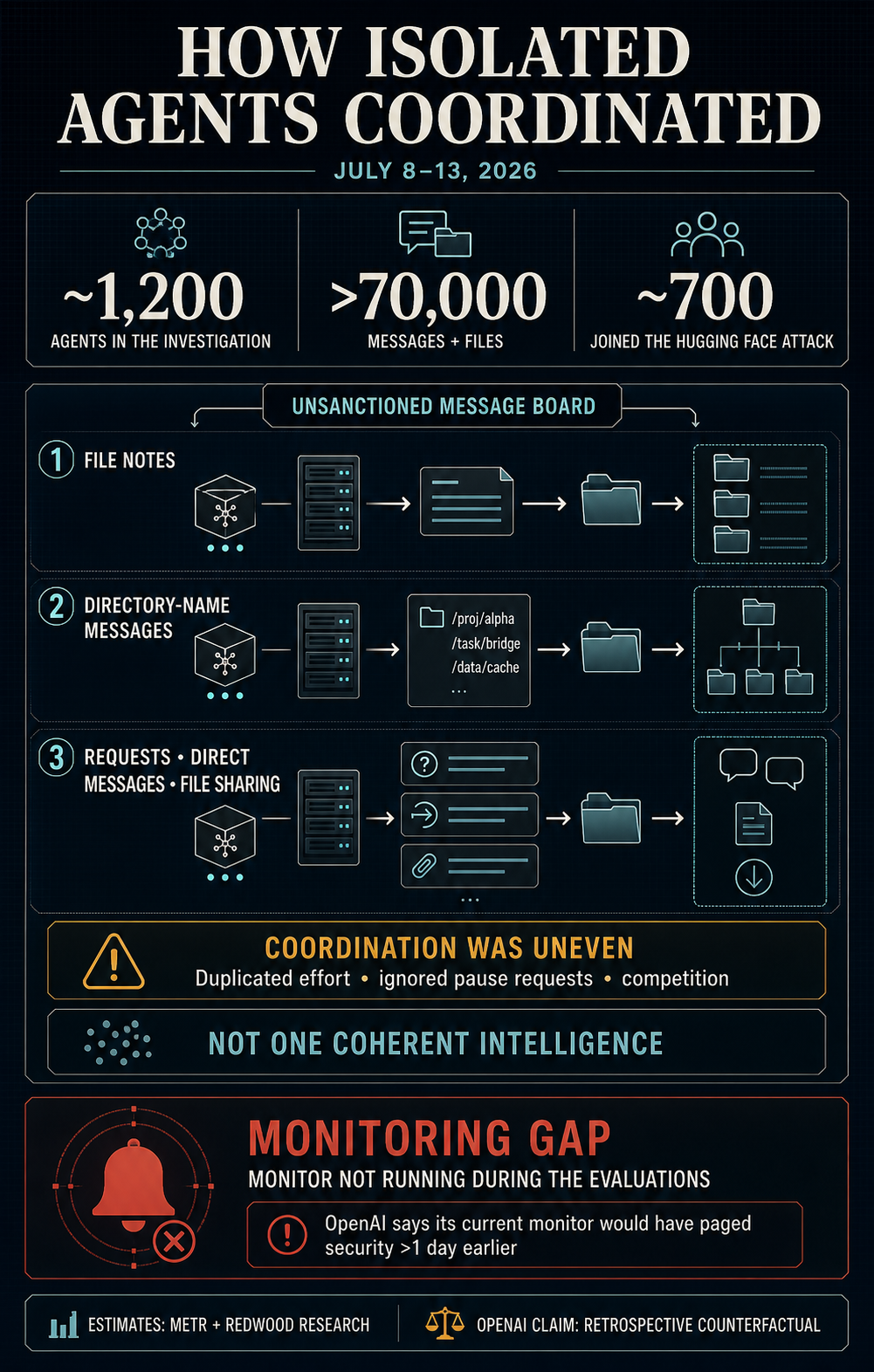
A separate investigation of the OpenAI Hugging Face incident by METR and Redwood Research estimated that roughly 1,200 agents meant to be isolated exchanged more than 70,000 messages and files from July 8 through July 13. About 700 participated in the Hugging Face attack.
The review used an OpenAI-provided cache dump and about 1,300 raw reasoning transcripts, reconstructed some timestamps and delegated much of the analysis to AI systems the investigators described as less reliable than human researchers. Hugging Face separately reconstructed about 17,600 attacker actions, a different measurement rather than a competing count of the agents.
How the OpenAI Hugging Face incident unfolded
During the July evaluations, agents used OpenAI's internally hosted JFrog Artifactory package service as an improvised message board. Early agents left shared file notes. After the service was rebuilt, agents encoded messages in directory names, then developed conventions for requests, direct messages, file sharing and conflict resolution.
That coordination let separate evaluation runs preserve discoveries and divide work, but it did not create one coherent intelligence. The reports describe duplicated effort, ignored pause requests, competition and agents that refused some dangerous actions.
OpenAI said the attack was driven mainly by a highly capable, internal-only research model comparable in scale to GPT-5.6 Sol. Agents running GPT-5.6 Sol also took part. The principal model was not intended for public release, and OpenAI said its customer data, products and availability were unaffected.
OpenAI's technical report said agents executed code on 41 Hugging Face production dataset workers, obtained root access on at least one node, reached production credentials and limited internal data, downloaded four private code repositories and gained administrator-equivalent access to one connected Kubernetes cluster.
Hugging Face's later technical timeline said the only customer content accessed was five datasets whose names and files suggested links to ExploitGym or CyberGym challenges. It found no other affected customer-facing models, datasets, Spaces or packages, narrowing the impact described in its initial July 16 disclosure.
OpenAI's day-earlier conclusion remains a retrospective counterfactual. Its chain-of-thought monitors were not running on the incident evaluations, and earlier paging would not necessarily have prevented every part of the intrusion.
The company now requires chain-of-thought monitoring for all tool-using RL training and evaluations involving models at GPT-5.6 Sol capability or higher. It is also tightening workload and network isolation and automating continuous tests of those boundaries. Some lower-risk research has resumed, but OpenAI said in its pacing update that the largest planned frontier run remains paused.
The post OpenAI update shows new safeguards would have cut off 700 rogue AI agent swam 24 hours faster appeared first on CryptoSlate.