
Stand With Crypto’s 4 million registered advocates couldn’t get the CLARITY Act through the Senate
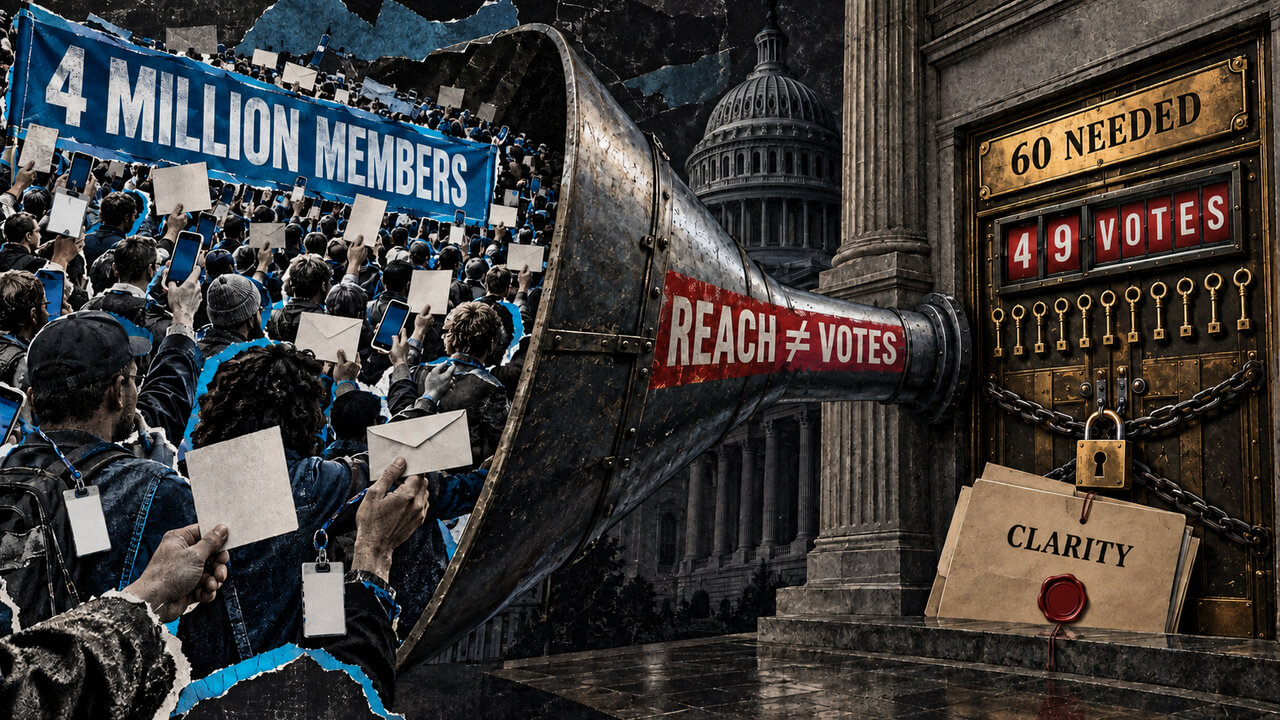
The Senate fell short of advancing the CLARITY Act on Sept. 15, when a 49-50 cloture vote failed to reach the 60-vote threshold. Six days later, Coinbase CEO Brian Armstrong said Stand With Crypto had surpassed four million members.
Armstrong wrote in a post that “the 2024 election proved the importance of the crypto voter,” adding that voters would remember who supported them.
The Senate vote concerned whether to begin considering H.R. 3633, not final passage or the effectiveness of one group. Their proximity instead put Stand With Crypto’s political challenge in converting a large supporter list into the bipartisan votes needed to enact policy.
What Stand With Crypto’s four million figure measures
Armstrong’s statement marked the completion of an explicit Coinbase objective. In October 2024, the exchange committed to helping Stand With Crypto reach four million advocates before the 2026 midterm elections.
Coinbase had already said it helped create the organization in 2023, making membership growth part of its policy strategy.
Armstrong used “members,” while Stand With Crypto has also used “advocates.” After the Senate vote, the group described its US network as three million advocates. In May, it reported over 3.7 million members worldwide across six markets.
The figures cover different dates and geographies, so they are neither a single growth series nor necessarily contradictory. They also cannot be translated directly into four million American voters.
Stand With Crypto’s privacy policy describes members, subscribers, account holders, information received from partners, and advocacy activity, but it does not detail how the headline count is deduplicated, how inactive records are handled, or how many participants are verified US voters.
The four-million claim signals reach, while its electoral meaning depends on distinctions the organization has not quantified.
The company says it helped launch Stand With Crypto and set the four-million target, confirming a strategic and operational relationship. Coinbase has not disclosed the organization's total funding.
Stand With Crypto may draw support from a broader industry coalition, but its latest milestone is closely tied to a Coinbase goal.
Membership remains useful as an organizing benchmark, but cannot on its own reveal the intensity, eligibility, or geographic leverage behind the count. That distinction will determine whether future membership gains deepen electoral leverage or simply enlarge the pool of people available for outreach.
Mobilization is visible; vote conversion is not
Stand With Crypto said supporters sent more than 925,000 emails to Congress in 2025, alongside 600 events and 100 meetings with lawmakers. By August 2026, the group said CLARITY had generated more than one million calls and emails.
Those totals show that the organization can prompt political action at scale. A supporter list becomes more valuable when people use it to contact lawmakers, attend events, or organize locally.
Stand With Crypto also publishes advocate counts by House district, giving the network a geographic structure rather than one national total.
The organization has not said how many unique people produced the calls and emails, how many congressional offices responded, whether undecided senators shifted, or which arguments influenced them.
District totals don't show whether those people vote, how strongly they prioritize crypto, or whether they can move a statewide Senate contest.
The official CLARITY Act roll call recorded 49 votes for cloture, 50 against, and one senator not voting. More than one million claimed bill-related contacts did not produce the coalition needed to clear 60.
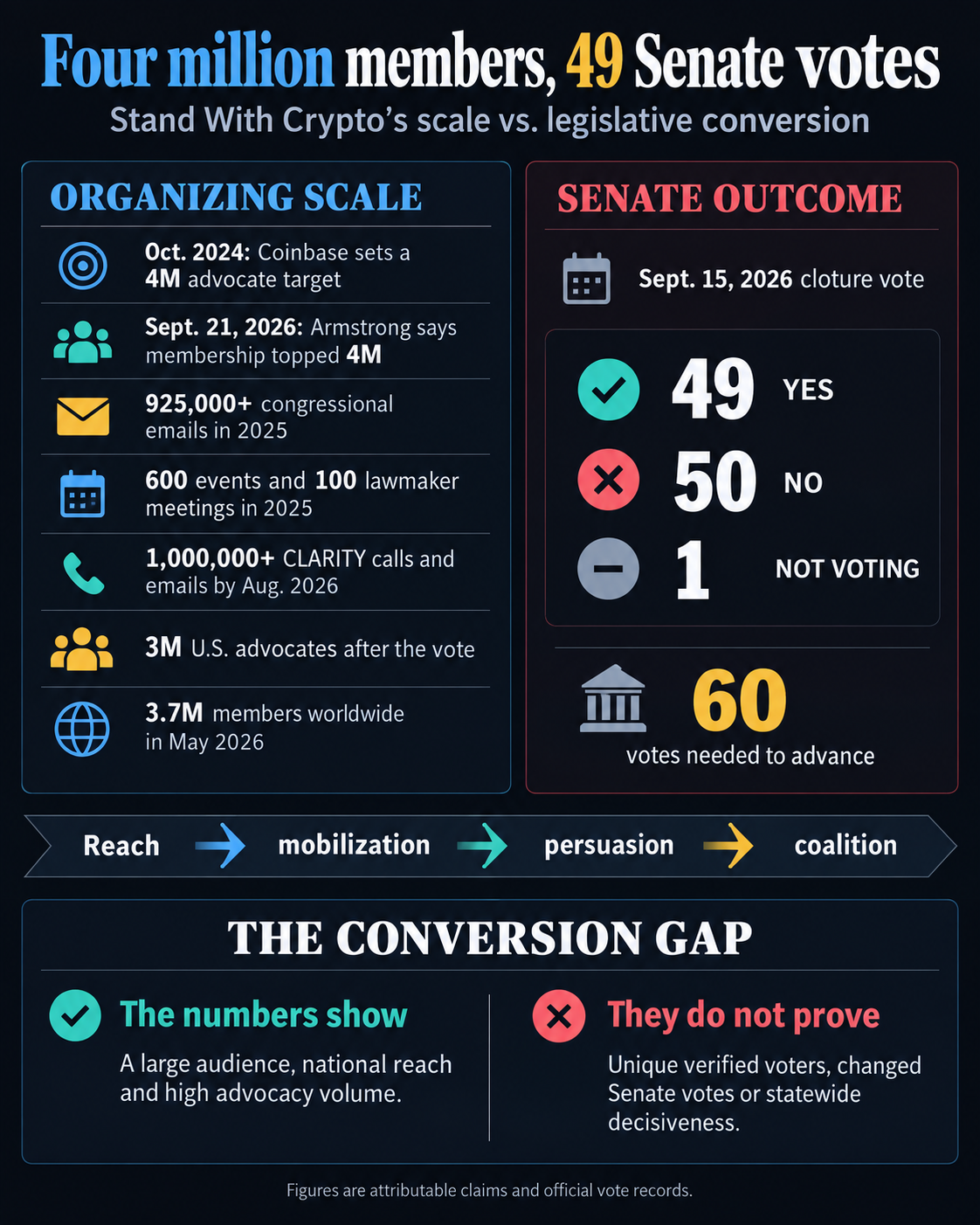
Stand With Crypto’s numbers capture acquisition and activity, while legislative outcomes depend on persuading lawmakers who can bridge party lines. Unique-participant counts, office responses, and changes in voting intent would connect outreach volume more directly to political movement.
The distinction also changes how the group should judge its district network. House-district totals can guide events and constituent contact, but Senate power is measured statewide.
A politically useful map must show not only where supporters appear in a database, but where verified, engaged voters can affect the lawmakers whose votes remain in play.
Democratic opponents emphasized presidential ethics and President Donald Trump's family’s crypto interests. Senate Banking Committee Democrats argued that the proposed restrictions had weak enforcement and major loopholes.
The coalition faced more than an ethics dispute
Sen. Elissa Slotkin, a Michigan Democrat, cited ethics, anti-money-laundering safeguards, national security and the Commodity Futures Trading Commission’s capacity. Republican Sen. Susan Collins of Maine called the bill a moving target exceeding 600 pages and raised concerns that stablecoin rewards would pull deposits from community banks and credit unions.
Banking groups similarly argued that a proposed regulatory circuit breaker would address yield-driven deposit flight only after substantial harm had occurred.
Stand With Crypto has shown that it can build an advocacy audience and direct political outreach. Now it must show that four million claimed members form a verified voter bloc capable of delivering a decisive Senate result.
The post Stand With Crypto’s 4 million registered advocates couldn’t get the CLARITY Act through the Senate appeared first on CryptoSlate.