
The latest $1.61 billion crypto ETF surge risks grinding to a halt against a 30-year US Treasury yield spike

Four consecutive sessions of U.S. spot Bitcoin ETF inflows have revived a regulated demand channel just as the U.S. Treasury offered investors a 2.973% real yield for nearly three decades.
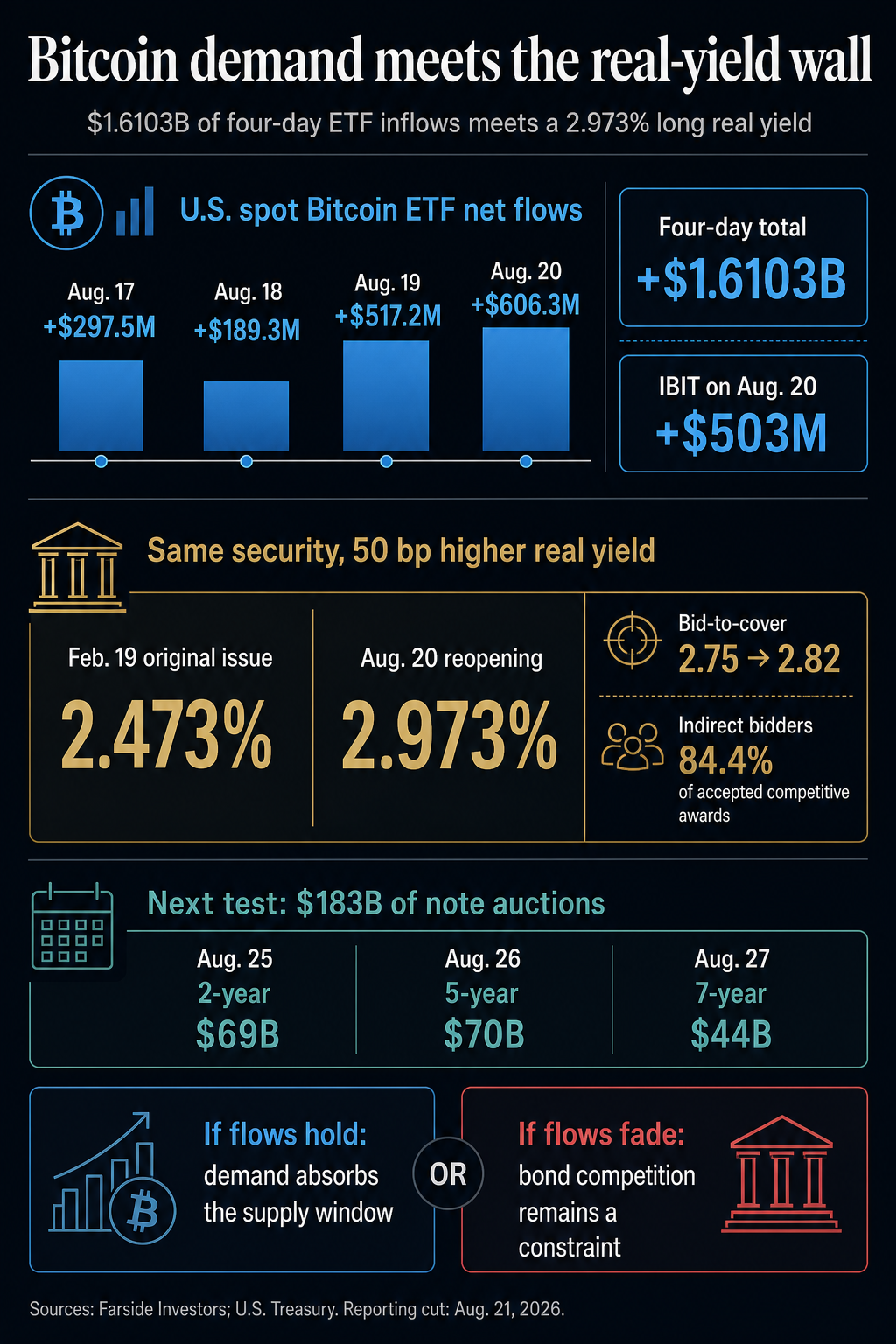
The ETF complex drew $1.61 billion from Aug. 17 through Aug. 20, according to Farside Investors. On Aug. 20, Treasury's February 2056 TIPS reopening cleared at a real yield 50 basis points above the same security's original-issue yield in February.
Bitcoin is trading near $77,821 on Aug. 21, up 7.2% over 24 hours. However, the next measure of the rally's durability arrives quickly. $183 billion of two-, five-, and seven-year Treasury note auctions take place from Aug. 25 through Aug. 27, with the long real yield still near 2.97%.
ETF demand meets a nearly 3% real yield
Farside recorded daily net inflows of $297.5 million on Aug. 17, $189.3 million on Aug. 18, $517.2 million on Aug. 19 and $606.3 million on Aug. 20. BlackRock's IBIT supplied $503 million of the final day's total.
The four-day sequence is more informative than a single-session spike, but its limits matter. ETF flow tables are end-of-day fund reports. They do not reveal the exact timing, venue or price of every underlying Bitcoin purchase, so the total measures the strength of a demand channel rather than the cause of a particular spot move.
Treasury's Aug. 20 sale created the competing benchmark. It was not a new 30-year security, but a reopening of the TIPS originally issued in February, leaving about 29 years and six months to maturity.
The reopening cleared at a 2.973% high real yield, compared with 2.473% when the same CUSIP was first sold in February. That like-for-like increase gave long-duration investors an inflation-adjusted yield almost 3% a year above the security's principal adjustment through 2056.
Auction participation did not collapse at the higher yield. Bid-to-cover improved to 2.82 from 2.75, while indirect bidders received 84.4% of accepted competitive awards. ETF demand therefore revived beside, not instead of, a well-bid sovereign alternative carrying a materially higher real return than six months earlier.
The market snapshots around the auction cannot rank the forces. A 9:06 a.m. ET update placed the nominal 10-year Treasury yield at 4.69% and the U.S. Dollar Index at 98.75, while a later closing snapshot put the 30-year inflation-indexed yield near 2.972%.
Treasury has scheduled $69 billion of two-year notes for Aug. 25, $70 billion of five-year notes for Aug. 26 and $44 billion of seven-year notes for Aug. 27. All three auctions are due to settle Aug. 31, according to the official auction calendar.
The combined $183 billion is gross issuance, not a forecast for how much money will leave risk assets. Auction demand, reinvestment and settlement timing will shape the effect on broader markets.
Treasury buybacks do not erase that distinction. Its buyback schedule set maximum $4 billion operations for 3- to 5-year coupons on Aug. 20 and 5- to 7-year coupons on Aug. 25. Those caps cannot be subtracted dollar for dollar from the note auctions because the eligible maturities, timing and settlements differ.
The outcome can be judged without assigning a single cause to Bitcoin's price. If Bitcoin and reported ETF inflows remain firm through the Aug. 25-27 auctions while the long real yield holds around 2.97%, the regulated demand channel will have absorbed a fresh Treasury supply window. If flows fade or Bitcoin reverses while real yields remain elevated, the rally will look more exposed to bond-market competition than the four-day inflow total suggests.
Either result will reveal more than the same-day collision alone. Investors will see whether Bitcoin's latest regulated demand burst can persist when U.S. government debt offers nearly 3% above inflation for almost 30 years.
The post The latest $1.61 billion crypto ETF surge risks grinding to a halt against a 30-year US Treasury yield spike appeared first on CryptoSlate.