
The Undercurrent: Three European Artists on Making Money Visible

Bitcoin Magazine
The Undercurrent: Three European Artists on Making Money Visible
Amsterdam helped lay the foundations of modern finance, but its artists were among its earliest critics. When speculative bubbles burst across Europe in 1720, Amsterdam printers and satirists responded with The Great Mirror of Folly, a collection of engravings and plays exposing the excesses of financial speculation.
Nearly three centuries later, the city hosted another monetary experiment. David Chaum, the cryptographer whose work on anonymous communication helped lay the groundwork for the cypherpunk movement, came to Amsterdam in the 1980s to work at CWI, the Dutch national research institute for mathematics and computer science. Around 1990, he founded DigiCash to develop private electronic cash. The company went bankrupt in 1998, a decade before bitcoin, but the dream of digital money was already taking shape.
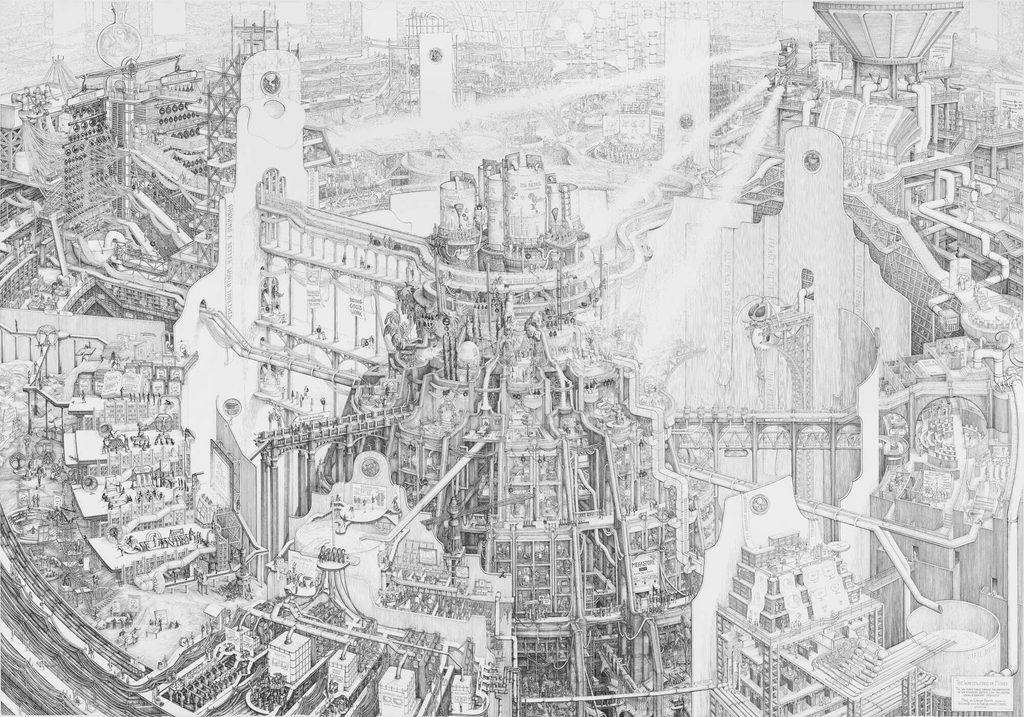
Last year at Bitcoin Amsterdam, BMAG exhibited The Waterworks of Money, in which Dutch artist Carlijn Kingma, working with financial journalist Thomas Bollen and researcher Martijn Jeroen van der Linden, depicted the monetary system as a vast irrigation network, with some areas flooded by liquidity while others remain dry. The drawing makes a complex financial system legible, exposing the mechanisms through which money is created, distributed, and concentrated.
This tradition of questioning money and making its hidden dimensions visible continues in the work of three European artists exhibiting at Bitcoin Amsterdam this November. ZETRA, RYR, and Cypherpunk Now draw from graffiti, political printmaking, hacker culture, and early bitcoin communities to explore the changing meaning of money.
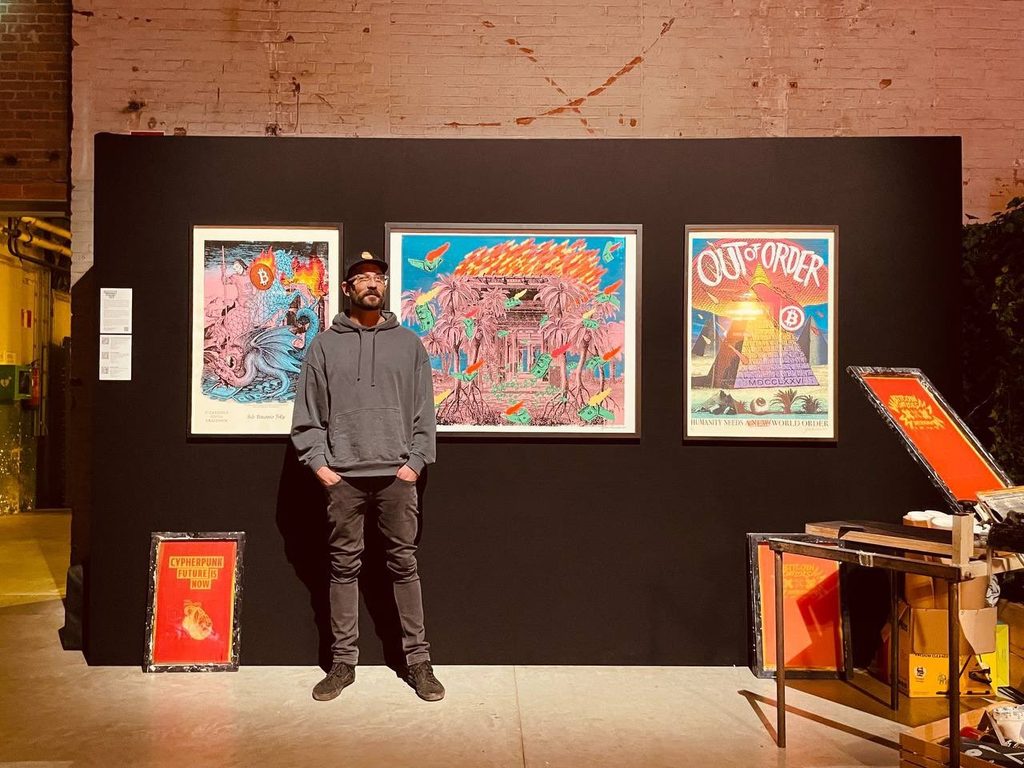
Martin Fischer joined the Prague art collective Ztohoven in 2003, a group known for inserting a fictional nuclear explosion into a live Czech Television broadcast. In 2014, the collective opened Paralelní Polis, a hackerspace whose café accepted only bitcoin, and Fischer designed its logo. As he told Bitcoin Magazine’s Aaron van Wirdum in 2020, the arrival of a screen-printing press the following year prompted him to produce his first prints. Since 2020, he has worked under the name Cypherpunk Now, developing a visual record of bitcoin’s evolving culture.
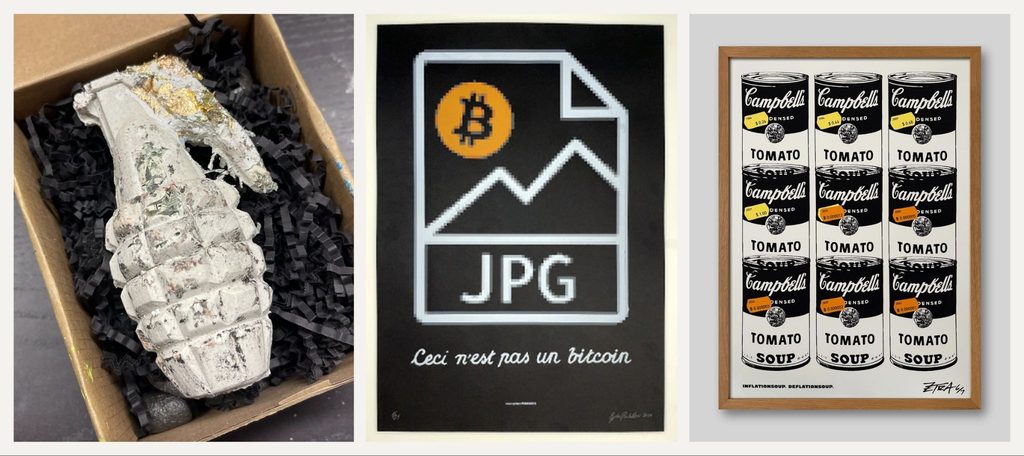
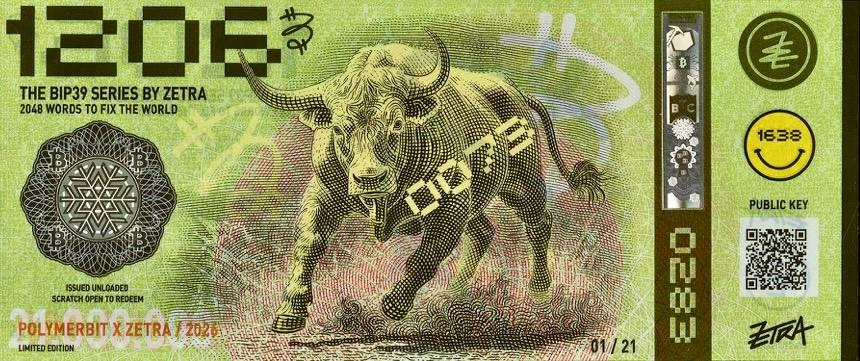
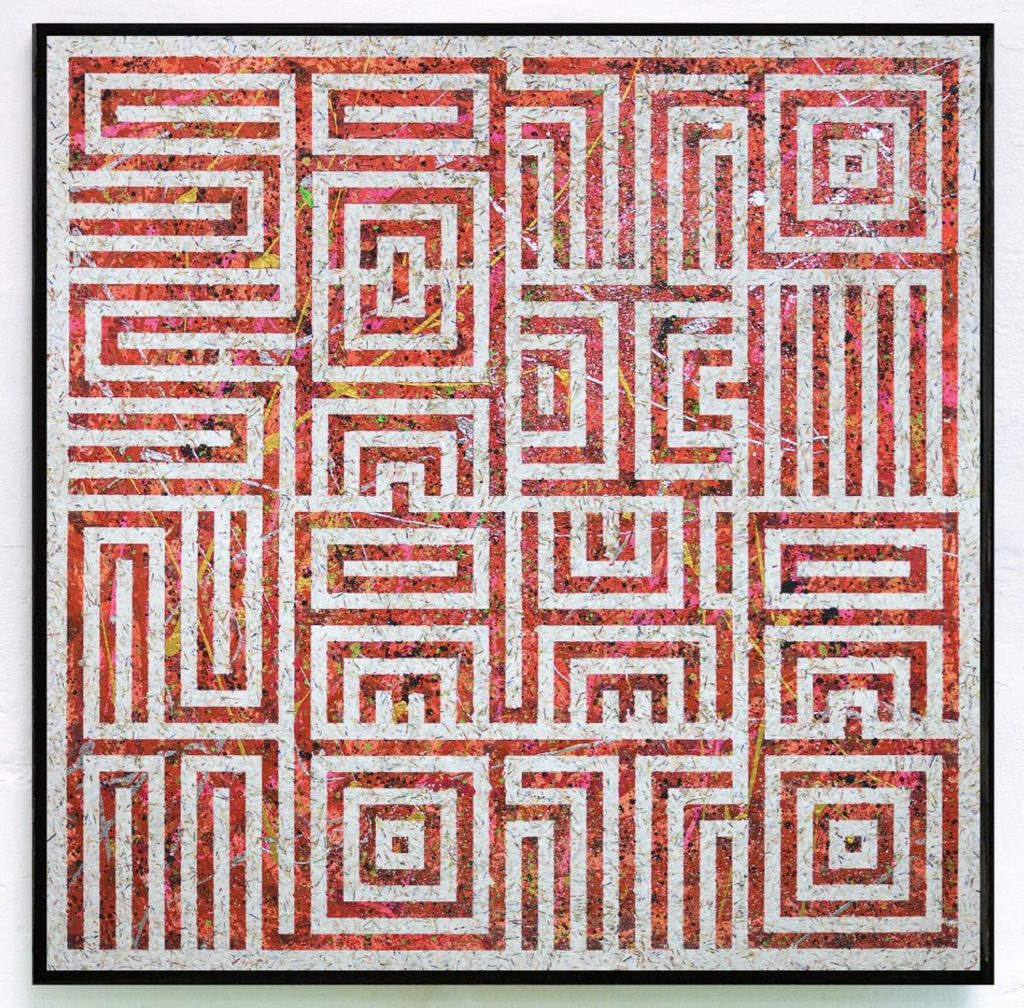
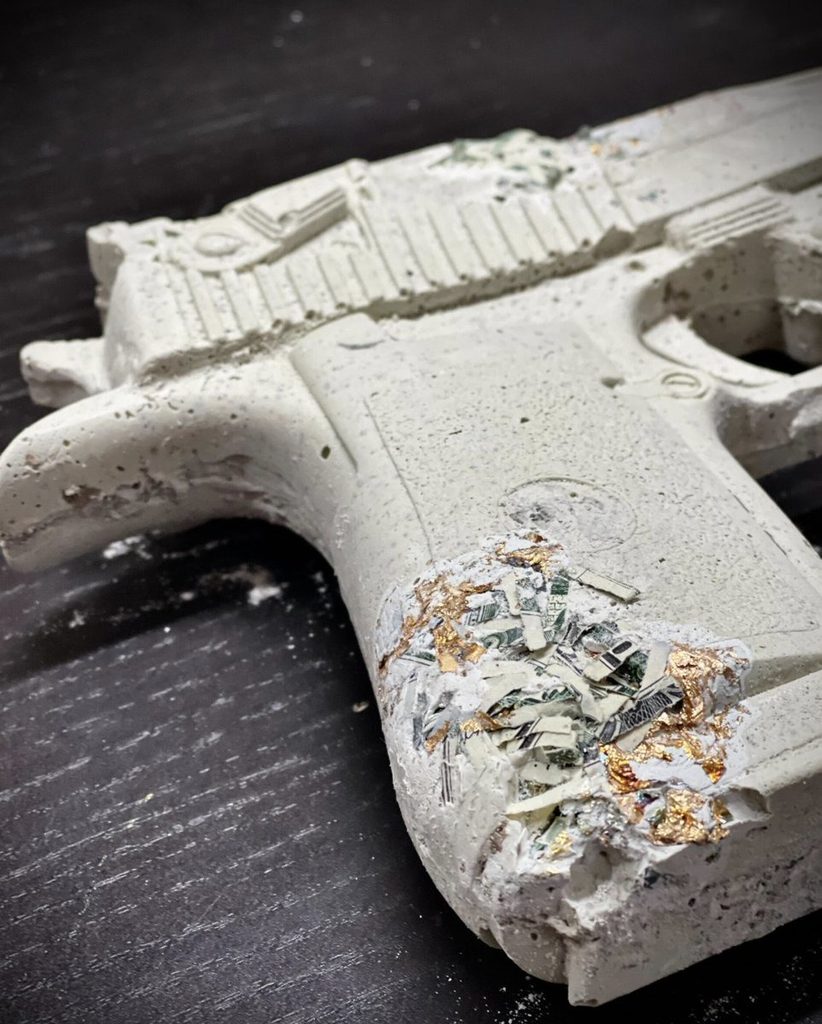
RYR and ZETRA both emerged from Germany’s graffiti scene but approach money from different directions. RYR uses currency itself as material, making paper from shredded banknotes, pigment from their ashes, and concrete grenades filled with shredded cash that he calls “artifacts from the future.” ZETRA, who began painting in the early 1990s and discovered bitcoin in 2017, examines what money can buy. His TOMATOSOUP paintings revisit Andy Warhol’s iconic Campbell’s Soup Cans to chart changing prices in dollars and bitcoin, while THE BIP39 SERIES explores the 2,048 words used in bitcoin wallet recovery phrases, including 1206/NOTE, a collaboration with Polymerbit.
Bitcoin has shaped these artists’ practices, their livelihoods, and the communities around them. Its growing acceptance by banks, investment funds, and corporations has also prompted some difficult questions about the movement’s original ideals and where its culture is heading.
BMAG: Andy Warhol turned Campbell’s soup into an icon of consumer culture, taking an ordinary commodity and elevating it into fine art. Your TOMATOSOUP series returns to that image but introduces something Warhol largely left outside the frame: the changing value of money itself. How did the idea of reworking Warhol’s Campbell’s Soup Cans first come about, and do viewers immediately recognize the commentary on inflation?
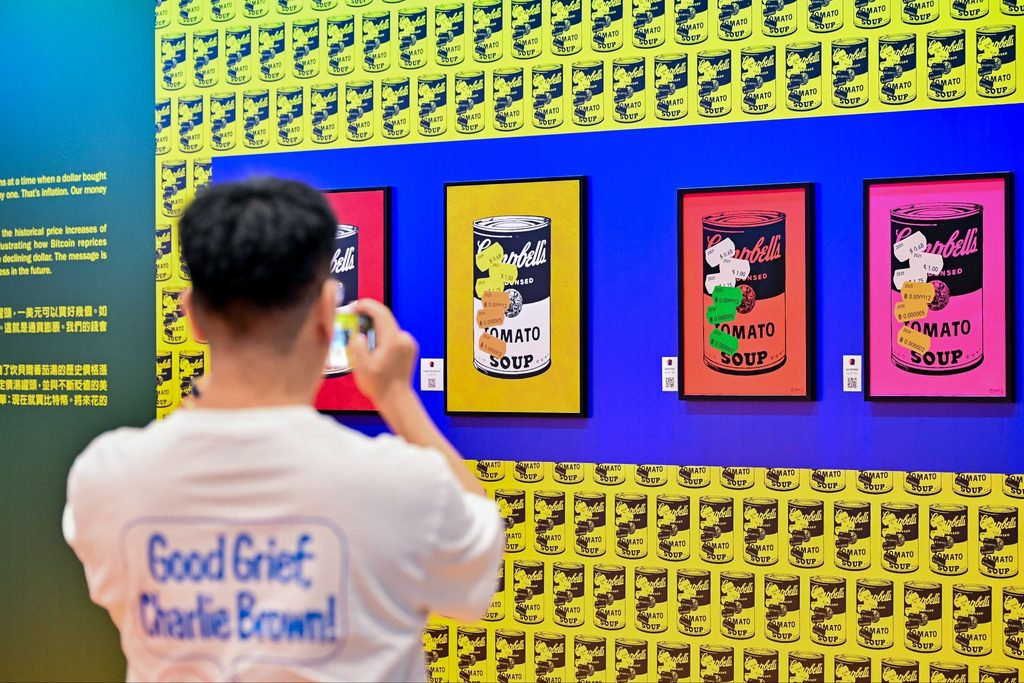
ZETRA: We frequently see iPhones and houses in our bitcoin Twitter timelines, showing how they become cheaper in BTC terms. I thought it would be fun to take something from art history instead, something more visually appealing, like Warhol’s iconic Campbell’s Soup Can.
For my TOMATOSOUP painting, I used real stickers placed on the can to show how the price of soup has increased in USD over the past decades, compared with the lower prices we might expect in BTC terms in the decades to come.
Bitcoiners looking at TOMATOSOUP generally understand it immediately. They know they’re in a better position as the purchasing power of fiat money continues to decline through inflation. Other viewers usually need a bit of explanation, and I’m always happy to help them understand.
BMAG: In THE BIP39 SERIES, you draw from the 2,048 words used to generate bitcoin wallet recovery phrases, turning ordinary words into artworks with a deeper significance for bitcoin holders. Can you unpack the different layers of inspiration behind the series and what they reveal about bitcoin, language, and the ownership of money for someone unfamiliar with these concepts?
ZETRA: Everyone who moves their precious sats into cold storage encounters 12 or 24 of these significant words, often early in their journey as a bitcoin newcomer. As mentioned, there are 2,048 words in a carefully curated list representing the power of self-custody.
I started going through the words one by one, imagining how each could be visualized in a physical form: the key visual for the word, its corresponding number, the style, and the medium I would choose. There are millions of possibilities for bringing these words to life through bitcoin art.
1044/LIST was the obvious choice to kick off THE BIP39 SERIES. Naturally, it features all 2,048 words presented as a list. As an ’80s kid, I had to choose 1638/SMILE as the second piece: a proper yellow smiley face, with the number 1638 in place of the eyes. It’s a fine art print on Alu-Dibond beneath a 6 mm acrylic glass cover. So clean.
Another work in the series is 0388/CORN, an obvious homage to Warhol once again. THE BIP39 SERIES will be an ongoing project for many years to come.
BMAG: You shred banknotes into paper and burn them to produce pigment. Artists have long manipulated currency to question where its value resides, but your work goes a step further by making destruction part of the creative process. Is there a contradiction in destroying money to create an artwork that may ultimately be worth much more?
RYR: Money is essentially a narrative system built on collective belief and obedience. It has worked for hundreds of years because we collectively agree on the story it tells and the value it represents. I’ve always been fascinated by that idea, particularly how something as ordinary as a banknote can carry so much meaning, authority, and perceived value.
I was looking for a different way to tell that story, both conceptually and physically. Back in 2017, I had an exhibition title in mind: To Cut a Long Story Short. I liked the cheekiness of it, especially in relation to money and the stories we attach to it. Shredding banknotes became a very literal interpretation of that title, but it also opened up an entirely new artistic medium for me.
Ultimately, I’m not simply destroying money. I’m taking an existing story, cutting it into pieces, and using those pieces to tell a new one.
BMAG: Your concrete weapons are presented as relics from a future in which the fiat wars have already ended. Yet bitcoin is increasingly held through the very financial institutions it was designed to circumvent. Is that a victory for the movement, or have the institutions simply absorbed the alternative?
RYR: I think that’s precisely what makes the story so interesting. When I created the concrete weapons, I imagined a future in which the traditional financial system had already fought its battle for survival. The weapons had become fossils, archaeological artifacts from a monetary conflict that future generations might struggle to understand.
My concrete weapons represent a future in which that battle is already history. Whether bitcoin ultimately wins or becomes part of the very system it challenged remains to be seen.
BMAG: Much of your work is made from the physical remains of money, at a time when currency is becoming increasingly digital and invisible. Do you think people are losing something in their understanding of money as it disappears from everyday physical experience?
RYR: I think we’re losing a physical connection to money, but not necessarily our understanding of it. Money has always been a narrative built on collective trust, whether printed on paper or represented by numbers on a screen. What fascinates me is how something as abstract as value can be represented by a physical object.
I don’t necessarily believe that art has to be authentic or entirely original. Almost everything has been done before. To me, art is a wonderfully human, almost plebeian way of expressing an opinion and giving ideas a physical voice.
Bitcoin will likely evolve into a much broader and increasingly regulated financial asset, but I hope its grassroots culture and artistic identity remain visible. That’s something my fellow artists and I will continue to contribute to, preserving the spirit of a movement that was cultural long before it became institutional.
BMAG: Paralelní Polis wasn’t just a place to discuss alternative monetary systems or a hacker meetup; its café was one of the first to adopt bitcoin as money. What were the early years of Paralelní Polis like, and what has your own experience been selling artwork for bitcoin?
Martin Fischer: Paralelní Polis was founded in 2014, during a bear market. The funny thing is, none of us who founded it even knew what a bear market was. We didn’t think of bitcoin as something that could make us rich. We saw it as uncensorable money and understood the changes it could bring to society. There was no speculation involved, and that’s what made those early days so great.
I sold my first screenprint for bitcoin in 2017, almost ten years ago, and many more since then. But practically every sale was a matter of survival. I spent most of the bitcoin I earned financing my next projects and continuing to make art.
I never managed to accumulate much bitcoin, but looking back, it gave me something far more valuable than investment returns: the freedom to remain an independent artist.
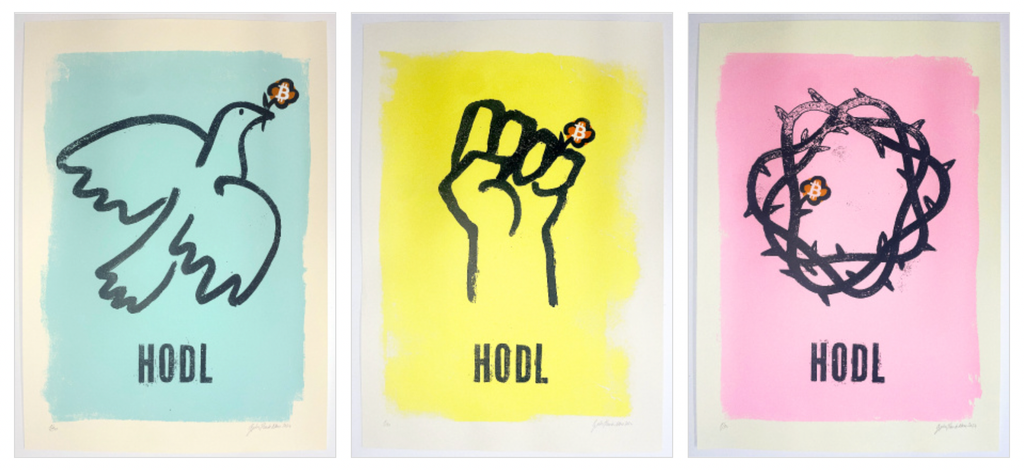
BMAG: Political printmaking has a long history in Europe, from Amsterdam’s financial satires of 1720 to twentieth-century protest posters. Your work emerged from Ztohoven, a collective that famously hacked a live television broadcast to show a fictional nuclear explosion—an audacious intervention, even by today’s standards. Ztohoven challenged institutions through disruption, while bitcoin uses game theory and economic incentives to create an alternative. Do you see bitcoin as a continuation of that same spirit of intervention, and your prints as an extension of it?
Martin Fischer: I think there’s a connection, but I wouldn’t say it’s exactly the same thing. With Ztohoven, we used art to question authority, challenge institutions, and expose how easily reality can be manipulated. Bitcoin doesn’t need to make a statement or provoke anyone. It simply offers an alternative that works without asking anyone for permission. That’s a much more interesting form of disruption to me.
But today, bitcoin has become so corporate and so intertwined with traditional banking that it’s hard to still see it as an anti-establishment movement. I don’t see this as a betrayal of its original ideals, but rather as a natural consequence of its success. That doesn’t mean I like where things are going.
What’s strange is that bitcoin’s fundamental principles haven’t really changed, but the way people perceive and use it certainly has.
And my screenprints? I still work with the original idea of separating money from the state while exploring the myths, memes, and legends of the bitcoin age. That’s what I enjoy most.
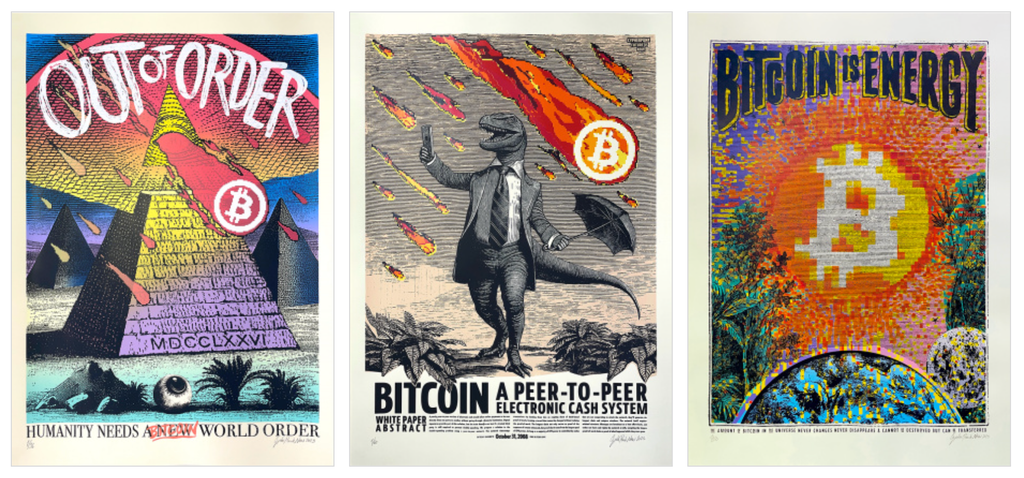
BMAG: Your Amsterdam presentation brings together more than a decade of work documenting bitcoin’s evolution from an underground movement to an increasingly institutionalized financial system. Looking across those prints today, has the movement changed more than you expected, or has your own perspective changed? Which of your prints are your favorites?
Martin Fischer: I like remembering the old days, when we were all part of the same tribe and our main enemy was Faketoshi.
Today? We have culture wars over JPEGs, Ordinals, BIPs, OP_RETURN, over what’s spam and what should or shouldn’t belong on bitcoin. What makes me saddest is that people who once fought together against censorship and for freedom now spend enormous amounts of energy fighting each other over what others should or shouldn’t be allowed to do with bitcoin.
Maybe it’s a natural consequence of bitcoin’s success. The bitcoin community has changed enormously, and so has my perspective on it. I’m definitely much more skeptical today of the idea that technology alone can automatically change society for the better.
As for my favorite works, Bitcoin Meteorite is definitely one of them. In this piece, I reworked the meme of banking dinosaurs watching their own extinction, incorporating the abstract from the Bitcoin white paper. It gave me my fifteen minutes of fame when Max Keiser and Stacy Herbert brought it into the spotlight.
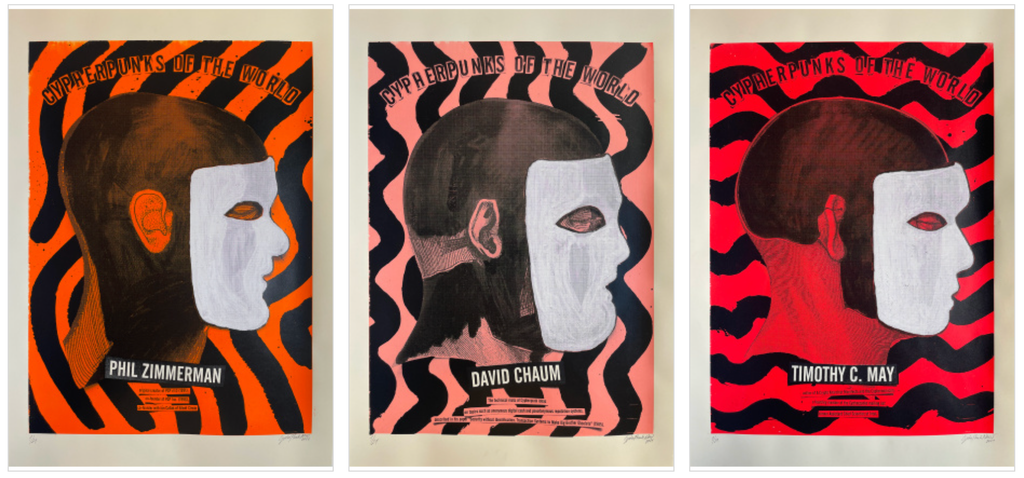
Then there’s Cypherpunks of the World. This project is important to me not only as a celebration of the cypherpunks and their legacy, but also because of its complexity. It started as a series of original collages, continued through handmade screenprints, and eventually evolved into animated NFTs and a virtual gallery. It’s one of my most elaborate projects, connecting different techniques and media while staying true to the original idea.
Among my more recent works, I really like Out of Order from 2023. It’s an incredibly detailed screenprint, and the first one where I finally managed to make absolutely no printing mistakes. That alone makes it special to me.
I also love St. Satosius Contra Draconem (2025), which is inspired by the classic depiction of Saint George fighting the dragon, reimagined through bitcoin mythology.
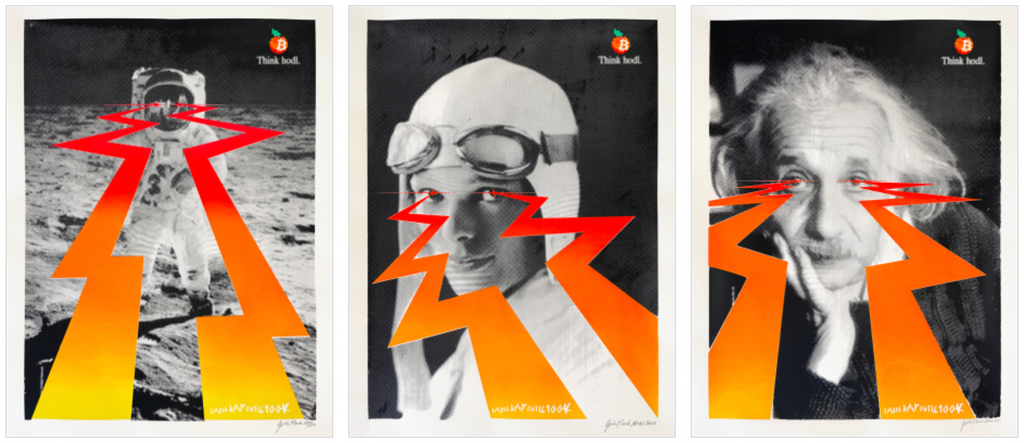
Works by ZETRA, RYR, and Cypherpunk Now, alongside other European artists, will be presented at Bitcoin Amsterdam, November 4–6, 2026, as part of the Bitcoin Museum & Art Gallery (BMAG) programming. Additional artworks and editions will be available through https://shop.museum.b.tc.
Explore more work by the featured artists at ZETRA, RYR, Cypherpunk Now, and www.martin-fischer.cz.
The Bitcoin Museum & Art Gallery (BMAG) organizes international exhibitions, auctions, and artist collaborations exploring bitcoin and its cultural implications. Learn more at museum.b.tc.
Join us at Bitcoin Amsterdam, Get your tickets here and use code BA26-BMAG20 for discounted admission.
This post The Undercurrent: Three European Artists on Making Money Visible first appeared on Bitcoin Magazine and is written by Dennis Koch.