
UK is hunting the $86 billion Russia-linked crypto pipeline as it moves to double sanctions fines
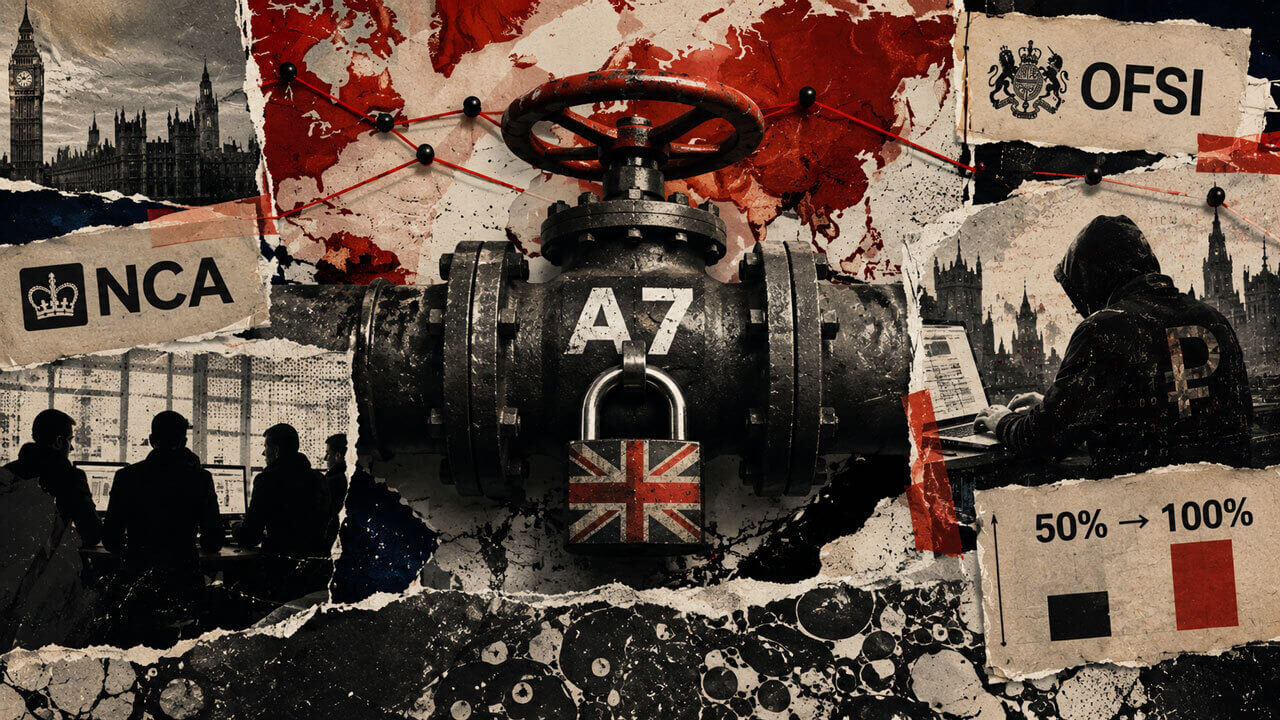
Britain is widening its Russia sanctions crackdown from named entities to the payment routes that keep sanctioned networks moving money.
On Aug. 31, the National Crime Agency issued its first nationwide industry alert on the A7 network, directing banks, payment providers and crypto firms to examine counterparties, intermediary wallets and cross-border infrastructure linked to Russia-related transactions.
Rachael Herbert, Director of the National Economic Crime Centre (NECC) at the National Crime Agency, said:
“The National Crime Agency and the National Economic Crime Centre are committed to targeting the nexus between organized crime and sanctions evasion. Last year, our Operation Destabilize targeted and disrupted a major Russian-speaking professional money laundering network, making it harder for them to operate and degrading the threat they posed.”
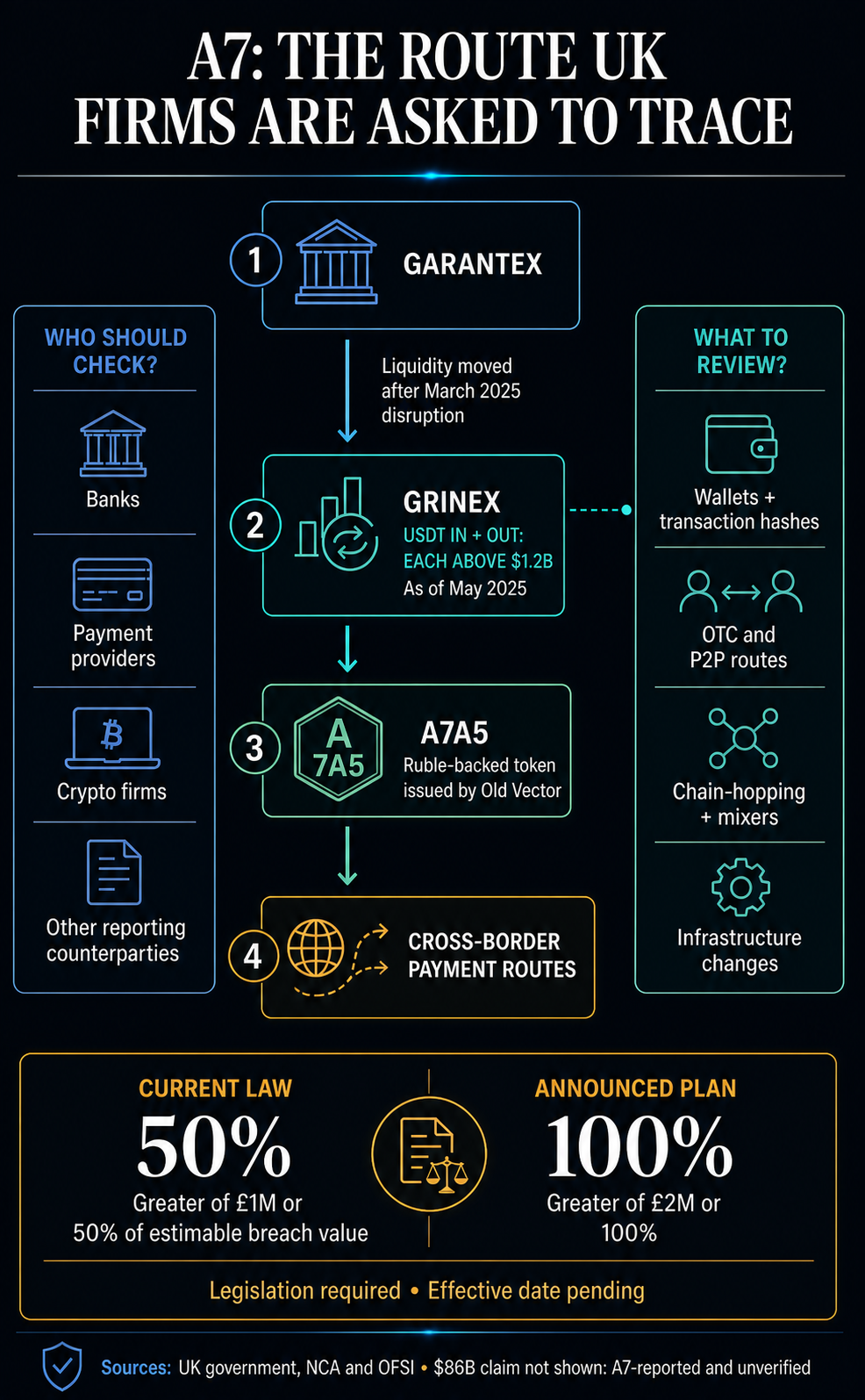
The move comes alongside a government plan to double the maximum civil penalty available to the Office of Financial Sanctions Implementation for breaches involving measurable funds or economic resources. The proposed ceiling would rise to the greater of £2 million or 100% of the breach value, from £1 million or 50% today.
A7 operates a cross-border settlement network that UK authorities say has used financial institutions in third countries, SWIFT and other international payment infrastructure to help Russian clients move funds around sanctions.
The network says it processed more than $86 billion in its first year, though that figure is self-reported and does not represent a verified measure of illicit flows.
The alert pushes compliance teams beyond conventional name screening. Authorities highlighted intermediary wallets, transaction hashes, decentralized exchanges, mixers, over-the-counter and peer-to-peer routes, services without know-your-customer controls, chain-hopping, VPN use and repeated infrastructure changes as signals that may warrant further scrutiny.
That approach reflects how sanctioned crypto infrastructure has evolved under pressure.
UK authorities previously assessed that crypto liquidity moved from Garantex to Kyrgyzstan-registered Grinex through A7A5, a ruble-backed token, after Garantex faced enforcement action. By May 2025, Grinex had recorded more than $1.2 billion each in incoming and outgoing USDT transaction volume.
The US Treasury separately said Garantex employees helped create Grinex infrastructure and that users regained account access or received equivalent value through A7A5.
For UK firms, the implication is that sanctions exposure may persist even after a crypto exchange, wallet or payment service changes names, jurisdictions or rails.
The tougher penalty proposal reinforces that shift. If enacted, firms could face fines equal to the full value of an estimable breach rather than half.
The change still requires legislation and has no effective date. OFSI would also retain discretion to impose penalties below the statutory maximum.
For now, the Aug. 31 alert marks a broader enforcement turn: Britain is asking financial and crypto firms to follow the route of Russia-linked money, not merely check whether the destination already appears on a sanctions list.
The post UK is hunting the $86 billion Russia-linked crypto pipeline as it moves to double sanctions fines appeared first on CryptoSlate.