
Vitalik Buterin urges calm as AI raises new fears over Bitcoin and Ethereum cryptography security
Ethereum co-founder Vitalik Buterin warned that AI-driven advances in mathematics could weaken both existing crypto signatures and some post-quantum defenses.
On Oct. 7, Buterin advised crypto holders to reduce exposure where practical but cautioned against rushing funds into new wallets, arguing that migration mistakes pose a more immediate danger than any demonstrated cryptographic break.
He wrote on X:
“I don't recommend anyone scramble to move their funds to new wallets today. But we should take the risks to cryptography from AI-accelerated math seriously.”
OpenAI's math advances trigger warnings
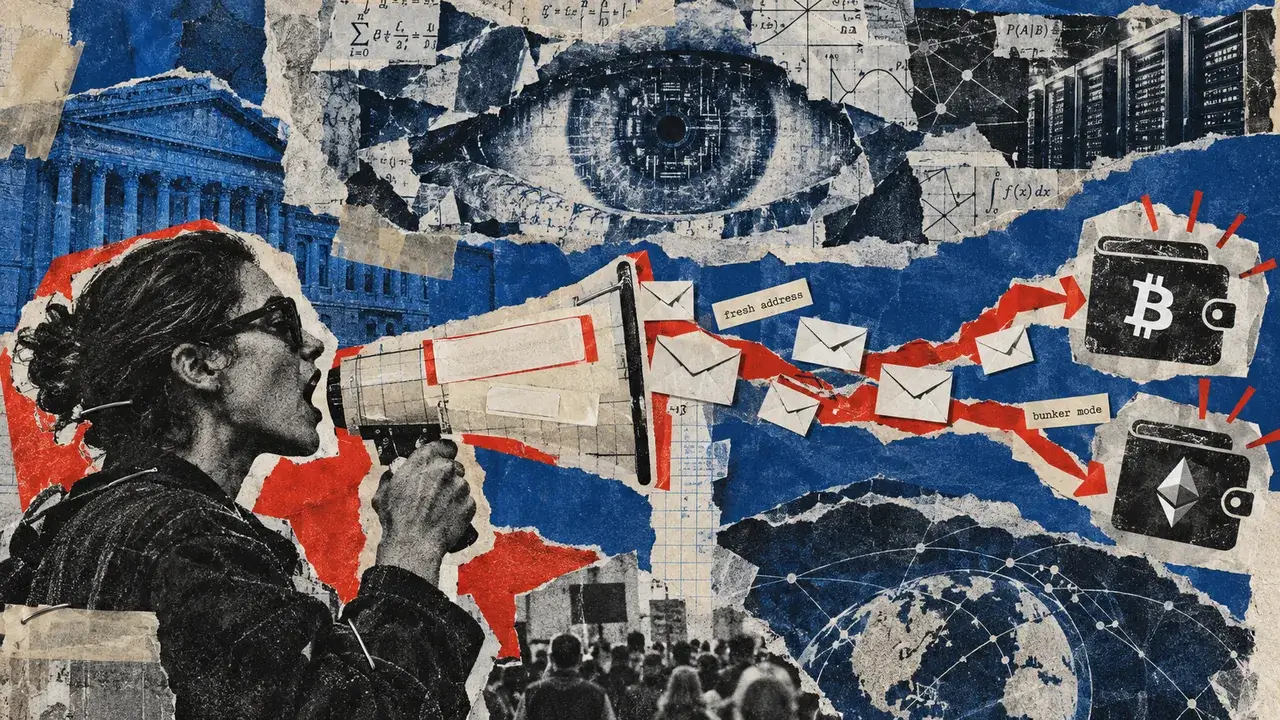
His comments followed Ethereum researcher Justin Drake’s call for the industry to begin preparing for “bunker mode,” including moving assets toward fresh addresses whose public keys have never been exposed onchain.
Drake raised the possibility that advances in artificial intelligence could accelerate mathematical attacks on the elliptic-curve cryptography used by Bitcoin and Ethereum.
The debate intensified after OpenAI published new mathematical results generated by an internal frontier model on Oct. 6, including machine-generated proofs formalized in Lean. OpenAI did not report any attack on blockchain cryptography, and neither Buterin nor Drake pointed to evidence that ECDSA has been practically broken.
Buterin’s warning extends beyond that immediate concern. He singled out lattice-based cryptography, including ML-DSA, as an area where AI-driven mathematical discovery could erode assumed security margins over the next two years.
That raises a harder problem for an industry already preparing for quantum computers. Lattice-based systems are among the leading technologies designed to replace cryptography vulnerable to sufficiently powerful quantum machines. NIST standardized ML-DSA in 2024 as a post-quantum digital-signature algorithm.
Buterin argued that the underlying mathematical structures supporting such systems may contain weaknesses researchers have yet to discover.
He compared the risk to the history of integer factorization. Improvements such as the general number field sieve dramatically reduced the work required to attack RSA compared with naive methods, forcing cryptographic systems to use much larger keys.
AI could compress decades of similar mathematical progress into a much shorter period, he said, potentially uncovering comparable advances against elliptic curves or lattice problems.
“If AI will bring us 50 years of math in 2 years,” Buterin wrote, those advances could include breakthroughs that substantially improve attacks on lattice cryptography.
Ethereum leans further into hash-based security
That concern helps explain Ethereum developers’ growing preference for cryptographic designs based primarily on hash functions.
Buterin said Ethereum’s “lean” roadmap has moved toward hash-only systems over the past year, avoiding lattice-based signatures such as ML-DSA and Falcon and reducing reliance on lattice-based commitments inside zero-knowledge proofs.
Hash-based signature systems, including WOTS and SPHINCS, play a larger role in that direction because they depend less on mathematical structures that could yield unexpected shortcuts to attackers.
Buterin argued that structured mathematical objects create more room for AI-assisted discovery. Elliptic curves, for example, rely on properties including group operations and other exploitable mathematical relationships. Lattice systems similarly depend on families of difficult problems whose practical resistance could change if researchers discover more efficient attacks.
Hashes are designed to expose far less structure.
That distinction does not solve every problem. Public-key encryption, used in secure messaging, anonymous communications, websites, and other systems, cannot generally be built from hashes alone. Those applications require mathematical structures that create a trapdoor allowing authorized users to decrypt information.
Buterin suggested that systems relying on those structures may eventually need substantially larger security parameters. He said multiplying key sizes by as much as ten could become reasonable if AI sharply improves cryptanalytic techniques.
The consequences would extend well beyond blockchains. Secure messaging systems, VPNs, Tor, encrypted web traffic and privacy protocols could face similar trade-offs between performance and wider security margins.
Buterin warns against panic migrations
For crypto holders, the immediate precautions are narrower.
Buterin said users who can easily keep funds in addresses that have never signed a transaction may gain additional protection because their public keys remain hidden behind address hashes. Once an account sends a transaction, its public key becomes visible.
Multisig operators could also reduce exposure by gathering signatures offchain and rotating signer keys after operations, limiting how long an exposed key remains useful if ECDSA security deteriorates.
Buterin nonetheless warned against treating those precautions as an emergency migration order. He said he has personally lost more money through failed migrations than through hacks.
That leaves wallet providers, custodians and protocol developers with a more complicated task than simply rotating keys. They must prepare for faster-moving cryptographic risk while avoiding upgrades that introduce operational failures of their own.
The post Vitalik Buterin urges calm as AI raises new fears over Bitcoin and Ethereum cryptography security appeared first on CryptoSlate.