
World Cup prediction markets hit $2B before kickoff as Spain and France go head to head

The FIFA World Cup has become a multibillion-dollar trading event before its June 11 kickoff, with prediction-market traders nearly split on whether Spain or France should be treated as the team to beat in the tournament.
Polymarket data show Spain and France each trading near a 16% implied chance of winning the tournament, ahead of England at about 11%, Portugal at 10%, and defending champion Argentina at 9%.
Prices on Kalshi, a regulated US-trading venue, show a similar race at the top, with Spain near 16.5%, France at 16.2%, Portugal at 10.5%, England at 10.1%, and Argentina at 8.9%.
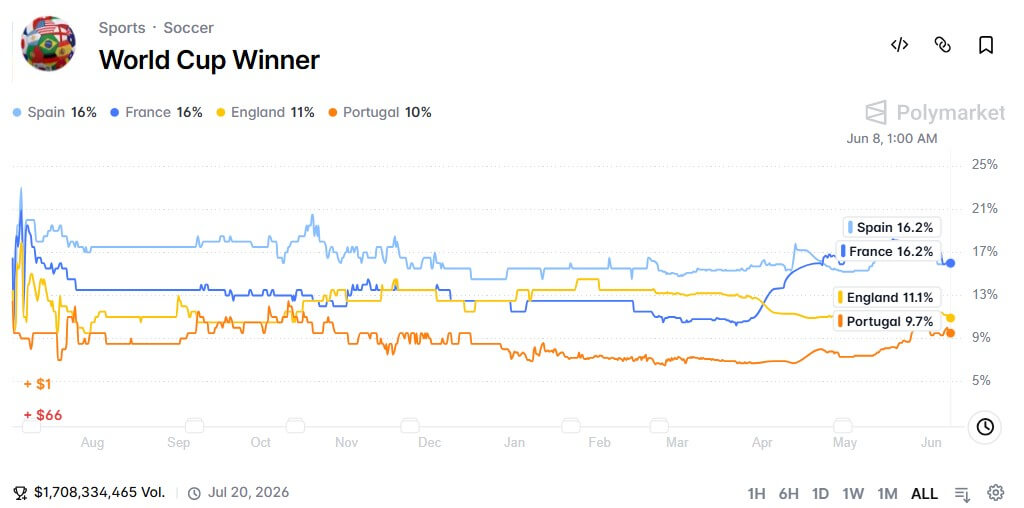
These numbers are not forecasts in the traditional sense, as they reflect where traders are willing to buy and sell event contracts that pay out if a team wins the tournament.
Still, the size of the market has turned the 2026 FIFA World Cup into an early test of whether prediction platforms can compete with sportsbooks during one of the most-watched sporting events in the world.
Already, Polymarket’s World Cup winner market has generated roughly $2 billion in trading volume before the tournament begins, while Kalshi’s comparable market has crossed $100 million.
The figures place the event among the largest sports markets yet for prediction platforms, whose rapid growth has pushed them into territory long dominated by licensed gambling operators.
World Cup gives platforms their largest sports test
For Polymarket and Kalshi, the World Cup arrives at a pivotal moment.
The 2026 tournament is the first men’s World Cup since prediction markets moved beyond their earlier base in crypto, politics, and macroeconomic events into mainstream sports speculation.
The event gives the sector its largest sports test yet, with a global audience, 48 teams, 104 matches, and weeks of shifting narratives that can be turned into tradable contracts.
Historically, sportsbooks have always given fans a way to wager on teams and players. Prediction markets are newer and add a structure closer to financial trading, where users can enter, exit, trim, or increase positions before an event is resolved.
In simple terms, prediction markets allow users to buy and sell contracts tied to future events. A contract trading at 40 cents implies a 40% market-implied probability and pays $1 if the outcome occurs.
This means the prices can move as traders react to injuries, team news, match results, tactical changes, and other developments.
That flexibility is central to the surge in World Cup activity.
A trader who buys Spain before the opening match does not have to hold the position until the final in July. If Spain wins its group comfortably or receives a favorable knockout draw, the contract price could rise and allow the trader to sell before the tournament ends. If a key player is injured or the team faces a more difficult path, the position can be reduced before it settles at zero.
The same logic applies to France, Portugal, England, and Argentina, whose prices remain close enough to keep the market competitive. France’s squad depth, Spain’s recent form, England’s attack, Portugal’s Nations League momentum, and Argentina’s status as defending champion have all given traders competing cases to price.
That has helped turn the winner market into a live trading venue rather than a static pre-tournament betting board. Prices can adjust after each match, press conference, injury update, or disciplinary decision. The result is a tournament-long market that tracks changing sentiment as the field narrows.
However, that scale does not make the market immune to bias. Prediction markets can still reflect momentum, public attention, fan loyalty, and uneven access to information.
For context, a national team with a large global following may draw more trading interest than a less popular side with a similar chance of winning. Traders can also overreact to short-term developments in a tournament where one injury, suspension, or red card can reshape the path to the final.
Still, the activity shows how sports have become a major growth channel for event-contract platforms.
Pew Research Center found that combined monthly global trading volume on Kalshi and Polymarket rose from less than $5 billion in September 2025 to about $24 billion in April 2026. That compares with about $14 billion in average monthly legal sportsbook wagers in the US last year.
Sports have been especially important for Kalshi, where they have accounted for the bulk of trading volume since the platform expanded beyond politics and macroeconomic events. Polymarket’s activity is spread more broadly across sports, politics, and crypto, but the World Cup shows how a single global event can concentrate liquidity across one set of contracts.
In view of this, several crypto companies, including President Donald Trump-related firms, are now trying to tap into that demand.
Exchanges and wallet providers, including Bitget, OKX, and Gate, have introduced World Cup-related products or campaigns aimed at turning global attention into trading activity.
The push reflects a broader shift in crypto marketing, with firms increasingly attaching products to major cultural events rather than relying only on token prices or blockchain-specific narratives.
Alvin Kan, chief operating officer at Bitget Wallet, said prediction markets are becoming a new way for users to participate in global events. He stated:
“The World Cup shows why this matters: billions of people are not only watching the same moments, but forming views, debating outcomes and acting on conviction in real time.â€
Regulators watch the line between trading and gambling
Meanwhile, the World Cup surge is landing as regulators, lawmakers, and state officials examine how far prediction markets should be allowed to expand.
Kalshi is regulated by the Commodity Futures Trading Commission (CFTC), while Polymarket’s main international exchange is not CFTC-regulated and has generally barred US users. Polymarket has also launched a US operation, though its international venue remains the larger marketplace.
The distinction has become central to the policy debate. Supporters say federally regulated event contracts can bring transparency, surveillance, and standardized market rules to a space that already exists through offshore sportsbooks and informal betting.
Critics say sports markets are gambling products by another name and could bypass state consumer-protection regimes if they are treated only as derivatives. In fact, several US states have argued that these prediction markets’ sports contracts amount to sports gambling and should be regulated by their local frameworks.Â
However, the CFTC has countered that these platform contracts fall within its regulatory jurisdiction.
Meanwhile, these concerns go beyond jurisdiction. As prediction markets grow, regulators are looking more closely at know-your-customer checks, market manipulation, insider information, fraud prevention, and data security.
Those risks become more visible when millions of users trade contracts tied to sports, politics, and other events with nonpublic information.
While sports contracts may avoid some of the insider-trading concerns that surround elections, they still carry information risks.
Team staff, medical personnel, agents, broadcasters, and others may know details about injuries, tactical changes, or player availability before the public does. Those details can move prices, especially in highly liquid markets tied to major teams.
In response, the platforms say they have surveillance tools and market-integrity systems to detect suspicious activity. Kalshi uses identity checks and monitoring programs. Polymarket has said it maintains a market-integrity framework and has referred suspicious wallets to law enforcement in prior cases.
The World Cup will test those systems at scale. A 39-day tournament with 104 matches gives traders a constant stream of new information and gives platforms repeated chances to show whether their markets can function through volatility, news shocks, and heavy retail participation.
The post World Cup prediction markets hit $2B before kickoff as Spain and France go head to head appeared first on CryptoSlate.