
Evernorth’s Nasdaq XRP treasury is approved, but its real buying power isn’t the $300 million expected
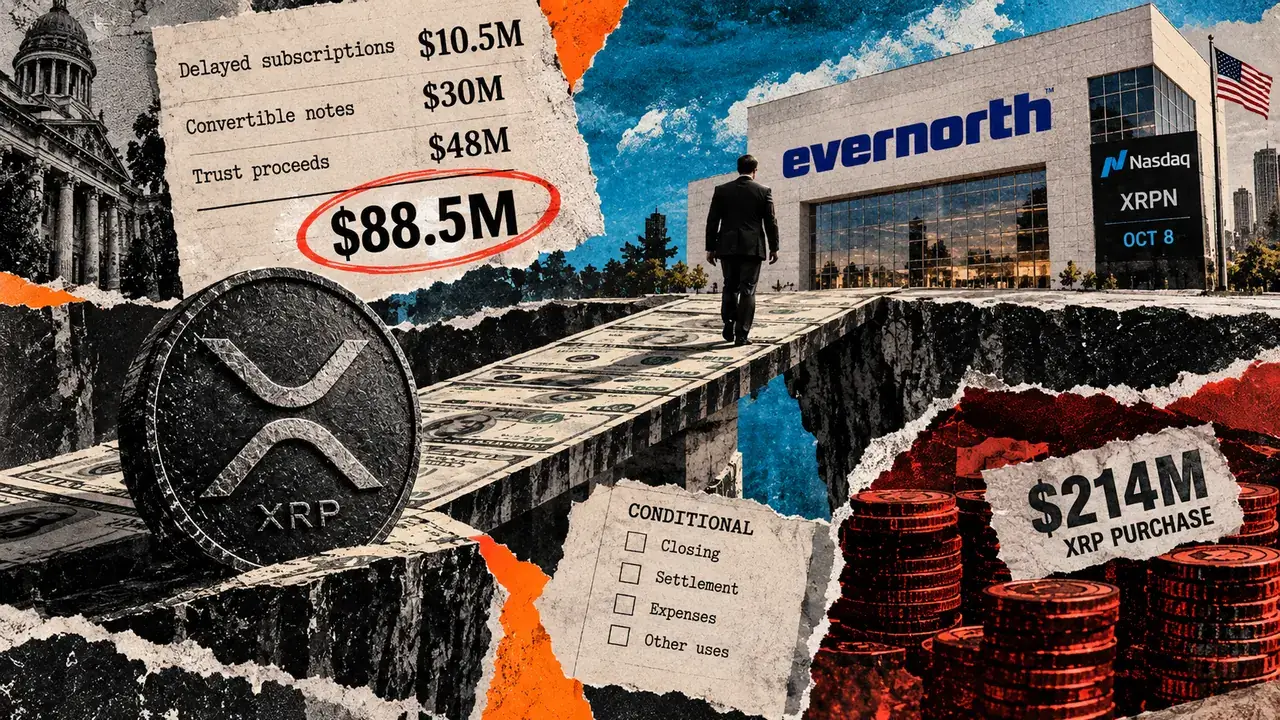
Evernorth’s shareholder vote has advanced its plan to become a publicly traded XRP treasury. Its next round of token buying hinges on cash left at closing: disclosed delayed subscriptions, conditional notes and expected trust proceeds imply roughly $88.5 million in gross sources if all three settle, before expenses and other uses.
Evernorth and Armada Acquisition Corp. II, its merger partner, announced on October 1 that shareholders had approved the combination on September 30. They expect closing on October 7, subject to remaining conditions, followed by trading of the combined company’s Class A stock on Nasdaq under XRPN on October 8.
That timetable brings the funding question into focus. The company’s approximately $300 million gross-cash figure includes a private placement program whose advance funding had already supported a roughly $214 million XRP purchase reported in November 2025. Cash already converted into tokens cannot finance the next acquisition a second time.
XRP was about $1.53 on CryptoSlate’s market page around press time.
Cash raised and cash still to settle
The October 1 announcement lists $225 million from related private placements, $30 million of incremental convertible-note financing and approximately $48 million of trust proceeds, all before transaction expenses. Those displayed components total about $303 million, so the company’s approximately $300 million summary should be read as an approximate amount.
The definitive proxy separates the private placements into $214.05 million of advance cash subscriptions and $10.5 million of delayed cash subscriptions. Together, those cash commitments total $224.55 million, consistent with the release’s rounded $225 million placement figure. The subscriptions also include separate XRP contributions.
The historical spending is substantial. In a November 4, 2025 disclosure, Evernorth reported purchasing about 84.37 million additional XRP at an average price of about $2.54, a purchase of approximately $214 million funded from its advance placement proceeds.
That purchase helps explain why the financing headline cannot be carried directly into a forecast of fresh spot demand. The advance cash had already financed the reported 2025 acquisition. The November 2025 announcement does not provide a precise current balance of unused advance cash, and a rounded purchase cost cannot resolve that balance.
The identifiable closing-linked sources can be separated from that historical deployment:
| Cash source | Disclosed amount | Condition or limitation |
|---|---|---|
| Delayed cash subscriptions | $10.5 million | Subject to subscription and combination closing conditions |
| Incremental convertible notes | $30 million | Issuance and payment conditioned on the business combination |
| Expected trust proceeds | Approximately $48 million | Company’s October 1 estimate, before transaction expenses |
Adding those amounts gives roughly $88.5 million in gross sources if they settle as described. This analytical gross total is not a company-announced net purchase budget or an upper limit. Expenses, operating needs and other uses reduce deployable cash, while any unused advance cash remains unmeasured.
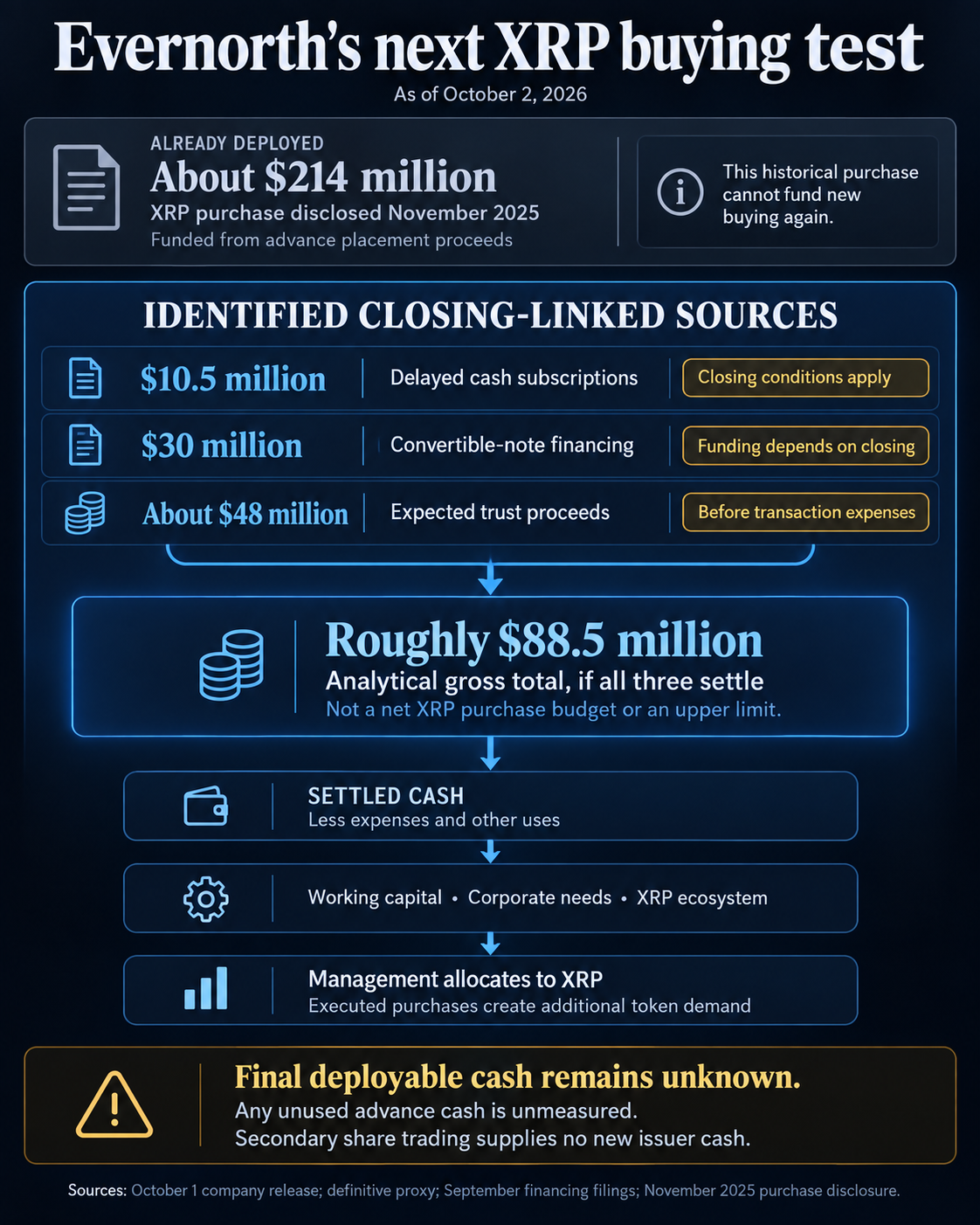
The financing itself remains conditional. Armada’s September financing disclosure says the $30 million note issuance depends on, and is expected to occur concurrently with, the business-combination closing. Shareholder approval clears one milestone; it does not establish that the investor’s cash has arrived.
Costs and allocation choices then matter. The proxy permits net subscription proceeds and trust cash to fund working capital, general corporate purposes and XRP purchases. The note agreement likewise permits general corporate uses, including acquiring XRP and other activities within the XRP ecosystem. Ecosystem spending therefore cannot automatically be counted as a spot-token purchase.
There are historical liabilities to reconcile as well. Armada’s June 30, 2026 balance sheet reported about $5.39 million in accounts payable and accrued expenses and a $9.2 million deferred underwriting fee payable. Those are dated SPAC figures, not the combined company’s final closing expense schedule; the underwriting payment also depends on trust funds remaining after redemptions.
The convertible funding also creates a financing obligation. Evernorth’s September 17 filing describes 4% annual payment-in-kind interest, which adds to principal, and maturity in 2031 unless the notes are earlier converted, redeemed or repurchased under their terms. Raising that money expands possible cash resources while adding debt; it does not itself establish a token acquisition.
The 473 million XRP forecast is a starting position
Evernorth expects to hold approximately 473 million XRP at closing. That figure combines a different set of questions from the cash budget: what was purchased earlier, what investors contribute in kind and what has actually settled into the treasury.
The November 2025 announcement had already described more than 473 million XRP as purchased and committed. The similar closing forecast therefore cannot be presented as 473 million newly acquired tokens following the September vote. The older figure also included commitments, so it cannot establish today’s completed holdings by itself.
The proxy illustrates the contribution channel. It describes a separate 50 million XRP related-party subscription and approximately 211.3 million XRP invested through the sponsor by RippleWorks. RippleWorks could withdraw its investment if the business combination did not consummate. These contractual contributions differ from spending company cash to buy XRP in the market.
A closing holdings update would consequently need a reconciliation, not just a headline token count. An increase caused by contributed XRP can enlarge the treasury without showing a contemporaneous cash purchase. Likewise, a higher dollar valuation of existing tokens would not establish token accumulation.
CryptoSlate’s September 28 coverage centered on the redemption risk to Evernorth’s funding. The October 1 trust-proceeds estimate advances the story toward the cash expected at closing, while leaving the final deductions and actual spending to be established.
The next useful signals are concrete. A completed-closing announcement and financing settlement would establish that the expected resources arrived. A net cash balance and paid-expense schedule would show what survived the transaction. Acquisition disclosures pairing cash outflows with purchased token quantities would show whether that money became additional XRP.
A holdings reconciliation would strengthen that evidence by separating purchases from in-kind contributions and any other treasury activity. Disclosed operating and ecosystem allocations would explain why some cash might support the business without appearing as new spot buying.
Nasdaq share turnover answers a different question. In ordinary secondary trading, consideration moves between the share buyer and seller. The issuer does not receive that trading volume as fresh treasury cash. A capital raise that supplies new company proceeds, an allocation to XRP and an executed purchase are separate steps.
For XRP demand, the consequential disclosure is how much settled cash Evernorth actually spends on additional tokens.
The post Evernorth’s Nasdaq XRP treasury is approved, but its real buying power isn’t the $300 million expected appeared first on CryptoSlate.