
Here’s what’s new in the final CLARITY Act before Tuesday’s Senate vote
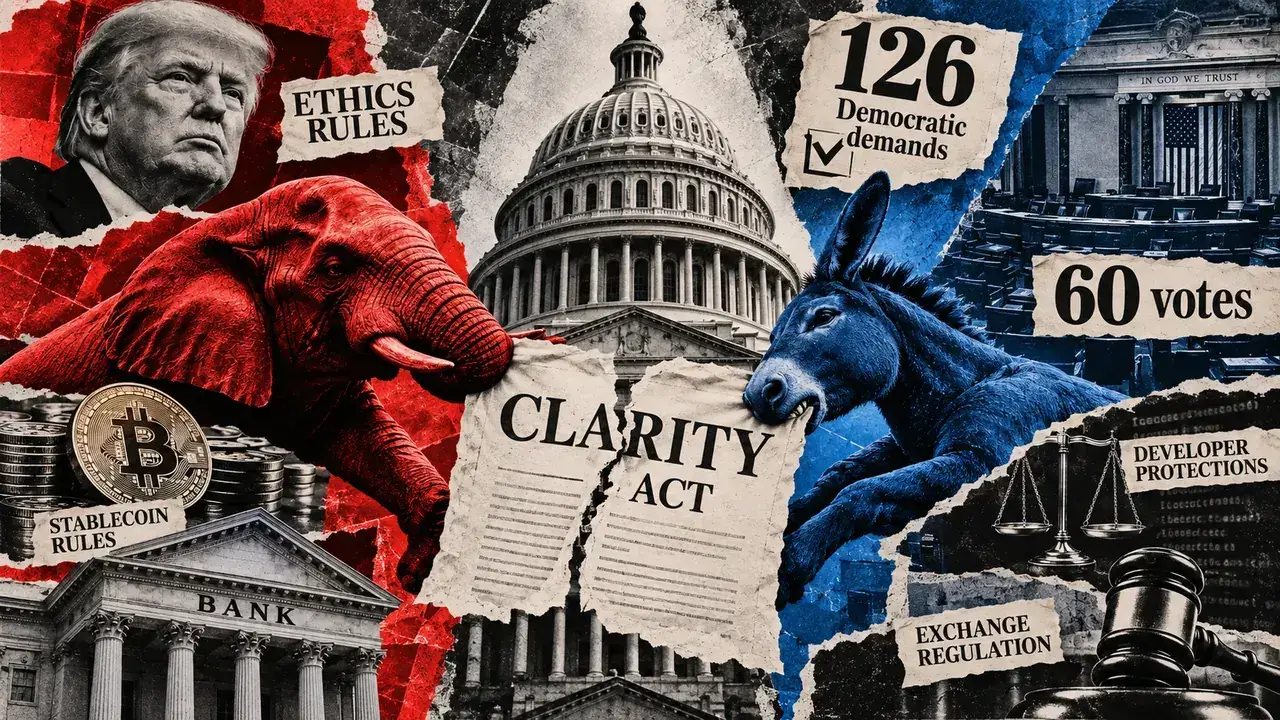
Senate Republicans rewrote key parts of the CLARITY Act as they made a final push for Democratic votes Tuesday.
“This text is truly bipartisan and includes more than 120 of Democrats’ demands,” Sen. Cynthia Lummis said Monday as she, Senate Banking Committee Chairman Tim Scott and Senate Agriculture Committee Chairman John Boozman released the final draft.
Republicans put the tally at 126 substantive changes Democrats requested over more than a year of negotiations.
The newest round is narrower, concentrating on four disputes that remained unsettled: ethics rules for federal officials, a backstop for stablecoin-related bank deposit flight, the scope of developer protections and tighter rules for digital commodity intermediaries.
Those revisions now face a 60-vote test when cloture on the motion to proceed to H.R. 3633 ripens Tuesday at 2:15 p.m. If cloture is invoked, Republicans plan to offer the final text as a substitute amendment and move the legislation into formal Senate consideration.
Trump ethics and bank safeguards target late-stage objections
The final round targets two of the most politically sensitive issues still hanging over negotiations: federal officials’ crypto interests and community banks’ exposure to stablecoin competition.
The ethics language gives state attorneys general a role in enforcing restrictions on covered officials who issue or sponsor digital assets or maintain significant financial interests in digital asset issuers.
Covered individuals would have to divest those interests or place them in a qualified blind trust. Violations could bring civil penalties equal to 20% of the consideration received in a prohibited transaction or $500,000, whichever is greater.
Those provisions would take effect 360 days after enactment or 60 days after the final implementing rule, whichever comes sooner. Republicans said the package reflects substantially all of an ethics proposal backed by Republican Sen. Thom Tillis and Democratic Sen. Ruben Gallego. They also said President Donald Trump agreed to the restrictions as negotiators worked through the remaining ethics dispute.
The stablecoin compromise adds a separate “circuit breaker” for community banks. If the Treasury secretary determines in writing that substantial deposit flight is occurring from those banks, Treasury would be directed to write rules restricting rewards available to payment stablecoin holders. That authority would expire 18 months after enactment.
The broader Section 404 compromise already prohibits covered digital asset service providers and affiliates from paying US customers interest or yield solely for holding payment stablecoins.
Activity- or transaction-based rewards can remain, subject to rulemaking, while providers would be barred from marketing stablecoins as bank deposits, investment products, government-backed products or FDIC-insured products.
Developer shield narrows as exchange rules tighten
Republicans also narrowed one of the crypto industry’s most closely watched legal protections, removing language that could have extended the Blockchain Regulatory Certainty Act more directly into criminal money-transmission cases.
The final draft keeps protections preventing software developers from being treated as money transmitters or financial institutions under the Bank Secrecy Act merely for developing software, but removes references to 18 U.S.C. 1960, the federal criminal statute covering unlicensed money-transmitting businesses. Miners and validators, which were previously outside the provision, are now covered.
Republicans describe the change in their list of Democratic concessions as restricting developer protections to the civil context, including the Bank Secrecy Act. The Agriculture title separately limits certain developer protections to cash and spot transactions, keeping derivatives regulation outside that shield.
The Agriculture provisions also impose stricter guardrails on affiliate trading and conflicts of interest involving digital commodity exchanges, brokers and dealers.
The Commodity Futures Trading Commission (CFTC) would write rules to identify, mitigate and resolve conflicts among affiliated businesses and entities holding multiple registrations, including vertically integrated trading structures.
The approach stops short of requiring exchanges to separate affiliated businesses. Republican committee materials leave the CFTC discretion to address conflicts through governance, disclosure, capital and customer-protection rules while directing the agency to avoid duplicative or unnecessarily burdensome requirements.
The final language also preserves state consumer-protection laws and says developer protections cannot create exemptions from derivatives law or affect tribal gaming. Republican materials released alongside the text say the legislation leaves the legal framework for prediction markets unchanged.
Broader concessions reach securities, AML and consumer rules
Beyond the four late-stage compromises, Republicans’ 126-change tally reaches deeper into the bill’s securities, enforcement and consumer-protection architecture, illustrating how far the Senate proposal moved during negotiations.
The revisions reduce the annual Regulation Crypto fundraising cap to $50 million from $75 million and establish a $200 million lifetime limit. Originators raising more than $25 million would need audited financial statements, while the ownership threshold triggering certain resale restrictions was lowered to 3% from 5%.
The bill also explicitly preserves SEC anti-fraud and market-manipulation authority and state consumer-protection remedies.
The Agriculture provisions add best-execution rulemaking, whistleblower protections, certified annual financial statements and restrictions on exchanges using their own digital commodities to satisfy capital requirements.
They also create a CFTC Office of the Retail Commodity Advocate and authorize $150 million for the agency.
Law-enforcement changes pull digital commodity brokers, dealers, and exchanges into Bank Secrecy Act and sanctions compliance, expand Treasury authority over foreign digital asset transactions tied to major money-laundering concerns, and allow temporary holds on suspicious transactions without civil liability in specified circumstances.
Crypto kiosk operators would face registration, fraud-warning, and disclosure requirements, along with a 72-hour holding period for certain transactions by new customers.
The bill also creates a Digital Asset Cyber Innovation Center and authorizes $150 million for the Financial Crimes Enforcement Network to expand anti-money-laundering capacity.
Those additions address categories seven Democratic senators identified in July when they said an earlier Republican draft fell short.
The group, which included Gallego, Mark Warner and Cory Booker, called for stronger provisions covering ethics, consumer protection, illicit finance, conflicts of interest and market integrity before the legislation advanced.
Republicans are now using the accumulation of those revisions to increase pressure on Democrats before Tuesday’s vote.
Lummis said Monday that Democrats had secured more than 120 of the changes they sought and argued that the resulting legislation should command bipartisan support. She added:
“If the Clarity Act fails, Democrats own what comes next: more 100 Democratic-directed changes wasted, consumers with zero federal protection, no disclosure rules, no delisting requirements for bad actors, stuck in the same unregulated system that has already cost Americans billions. They wrote the fix. They must pass it.”
The political test now shifts from what Republicans were willing to rewrite to whether the senators whose objections helped produce those concessions believe the final language goes far enough. A successful cloture vote would open the next stage of Senate debate and amendments rather than complete passage of the CLARITY Act.
The post Here’s what’s new in the final CLARITY Act before Tuesday’s Senate vote appeared first on CryptoSlate.